2016-05-11

Nakasendo Walk (12) Iwamurada(22/69)-Ashida(26/69): May 4, 2016


I continued my walk from Iwamurada, the 22nd shukuba station. It is near from the Sakurdaira railway station of the Hokuriku Shinkansen bullet train. It is in Saku City.

I could see many faces of Mr. Asama in the Iwamurada area. In one view, the mountain stood behind the central part of Saku City. In another view, Mt Asama was behind vegetable fields.

I also saw many apple fields along the street. Some were large and some were small. The white flowers were open when I walked there and the trees will have many apples fruits in autumn. (see the 2nd photo from the top)

I have learned that the shopping street offers services to help mothers to take care their babies. They also provide kids services to help their studies. Helping child care and basic education is a big challenge throughout the nation. Iwamurada's case is a good example.

Saku is also famous for its carp dished. I tried the full course, which included fresh, boiled, fried sweet-tasted and vinegar-tested carp. It was too much, but I enjoyed the traditional taste.

I moved into Shionada, the 23rd station. It locates at the side of the Chikuma River. The river changes its name to Shinano River in the lower part and is the longest river in Japan. Mt. Asama over the river was beautiful. (see the top photo)

There also are apple fields around the area.

I walked into Yahata, the 24th station. They produce good rice here. I had a talk with local farmers and they said that rice planning is scheduled in the middle of May. The water was introduced into the fields. (see the 3rd photo from the top)

Some fields have been converted into the site of solar panels.

There are many sculptures of Buddha, God and Goddess along Nakasendo. I felt the number increased after entering into Nagano Prefecture. At Yahata area, I found some impressive examples.

I moved into Mochizuki, the 25th station. It was famous as a place to produced good horses. I found a horse was carved in the cover of a manhole.

I passed the village of Motai before arriving in Ashida, the 26th station. Travelers of the Edo period took breaths or had meats at Motai. There remain old traditional houses here. I found thay were well preserved.


Nakasendo Walk (11) Kutsukake(19/69)-Iwamurada(22/69): May3, 2016


The Nakasendo in the eastern part of Nagano Prefecture or Saku area is called Shinano-ji. I walked there in the second part of the Golden Week holiday. It was nice season for walking outside. The air was fresh and the mountains were beautiful.

Today’s walk started from Kutsukake, the 19th shukuba station.

I walked a few kilometers along the gentle rising slope and arrived in the district of Oiwake, the 20th station. It locates at about 1000 meter high above the sea level. It is the highest shukuba station not only in Nakasendo, but also in all stations of five major routs of the Edo period. The five routs are Tokaido, Nakasendo, Koushu Kaido, Nikko Kaido and Oushu Kaido.

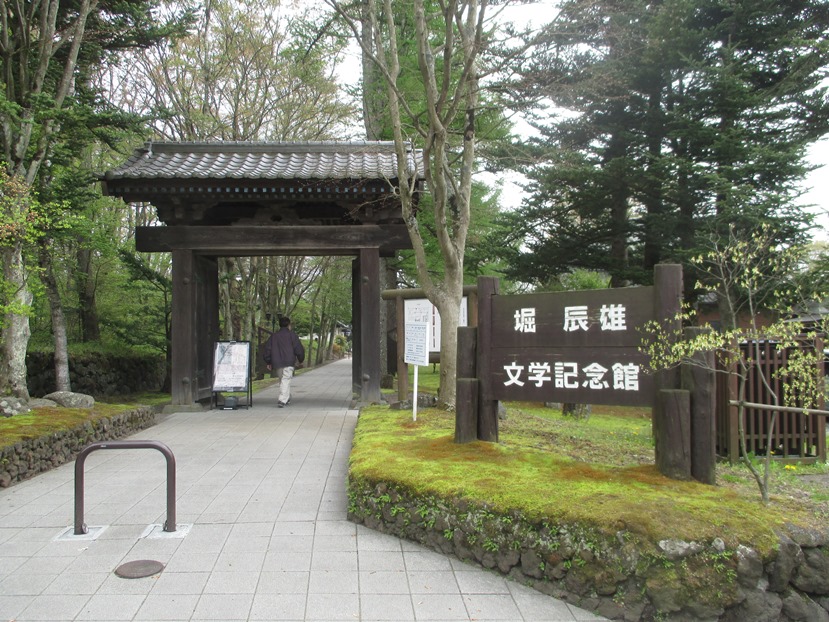
Oiwake used to be a sanatorium in the early 20th century. Many patients with tuberculosis and other diseases stayed here. Famous novelist Hori Tatsuo was one of them. The tradition of literature remains even today. I found Hori’s literature memorial attracted tourists. (See the end photo from top)


A second-hand book shop was open in front of the memorial. I also found small cottage-shape boxes here and there in the area. They are placed to exchange used books.

There stands a Nakasendo museum near Oiwake station. It was built 12 years ago by a Nakasendo specialist Yutaka Kishimoto. Interesting materials including Ukiyoe prints, art crafts of the regions, photos and books are displayed. I was warmly welcomed by Mr. and Mrs. Kishimoto and stayed nearly two hours. Their talks were interesting.

There spread large fields of lettuce at the sides of Nakasendo near Otai, the 21st station. Some fields were covered with the nets. They are necessary as the vegetables were grown without using pesticide here. (see also the top photo


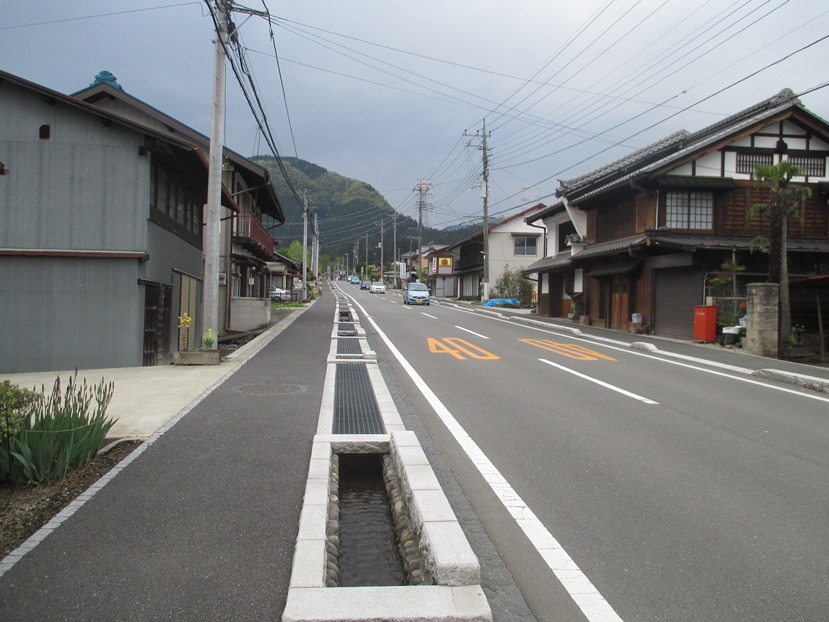
I saw a waterway places at the side of the street in Otai station. It was in the center of the street in the Edo era. Now, it is replaced. I found that the water was affluent and clean.

I mover westwards and arrived at Iwamurada, the 22nd shukuba station. It is near to the Sakudaira station of the Hokuriku Shinkansen (bullet train).


2016-05-02

Nakasendo Walk (10) Sakamoto-Kutsukake: May 1, 2016


I walked today from Sakamoto, the 18th shukuba station, through Karuizasa to Kutsukake. The course included steep mountainous roads around the Usui Pass and fashionable shopping streets in Karuizawa.

Today’s walk started in Gunma Prefecture and finished in Nagano Prefecture.

The altitude of Sakamoto station is about 460 meters. I climbed up the mountains in the Gunma-Nagano border area. The mountains were covered with fresh green. Some parts of the roads were very steep. (see also the photo 2nd fro the top)

I met tourists including those from Australia. Exchanging ideas is always a fun. 

The samurai soldiers in the Edo era ran up the roads. A marathon race is now held in the course. The sign boards of the marathon race were placed at the roadsides.

It took about two and half hours before arriving at the Kumano Shrine, which is about 1200 meter high. The prefectural border runs at the center of the shrine.

The panorama from the viewpoint was fantastic. I saw famous mountains including Mt. Asama, the Yatsugatake mountains, Mt. Myogi and Mt. Akagi. People can see Mt. Fuji when it is fine. (see the top photo)

I walked down the slope about 30 minutes and arrived at Karuizawa, the 18th shukuba station. The town has been developed as a summer resort after the Meiji period.

A Canadian priest Alexander Shaw was one of the first foreign residents stayed here. His church remains.

The old shukuba area has turned into a modern shopping street. Local people, tourists, Japanese, foreigners, old and young people and doge – all enjoyed their times.

I saw many cyclists in the town. Most of them were Chinese.

I walked westward and entered into the Kutsukake, the 19th station. Mr. Asama is quite near from here.


The Naka-karuizawa railway station is quite near from the old sukuba station. The building is also used as a library and a community center.


2016-04-30

Nakasendo Walk (9) Matsuida-Sakamoto: April 30, 2016


My Nakasendo walk continued. Today’s walk started at a place between Annnaka and Matsuida, the 16th shukuba station, passed Matsuida station and arrived at Sakamoto station, which locates at the foot of the Usui Pass and is the last station in Gunma Prefecture.

As I approached Matsuida, the scenes of the Myogi Mountains became bigger. The mountains have sharp slopes; the shapes are impressive. I enjoyed seeing the mountains in the town and over the fields.

Nakasendo has turned into a shopping street here. Open air markets were held when I visited Matsuida.

I passed Yokokawa before arriving at Sakamoto. Yokokawa Railway Station used to be a base station to cross the Usui Pass by the Shinetsu line. The Abt rack system, one of rack-and-pinion railways, was introduced here in the late 19th century and survived till 1963. It changed to the Class EF63 (EF63) electric locomotives and finally finished the operation in 1997 when the bullet train line was open.

Now, Yokokawa railway station is the last station of Shinetsu line which connects Takasaki and Yokokawa.

A special run of a steam locomotive train was planned when I visited Yokokawa.

Many locomotive fans were waiting the photo-shot chances along the railway.

Famous “kamameshi” lunch box was developed more than half century ago and became popular for the travelers because the trains stopped there for a while for their locomotive systems’ exchanges and people preferred to eat while waiting. Now kamameshi is popular not only here bat throughout the nation.

There are several kamameshi stores near the railway station. The Myogi Mountains stand behind.


A check point of Nakasendo or sekisho was placed near Yokokawa in the Edo era. The gate is preserved.

I met many tourists, including foreign cyclists, at Nakasendo around here. (see the 2nd photo from the top)


A walkway has been developed along the old rack-and-pinion railways.

The rail tracks are preserved in some parts.

It has many tunnels.

A railway bridge is kept, too. (see also the 3rd photo from the top)

It was a big fun for me to walk along the trail.


The Sakamot shukuba station is about 500 meter high. Nakasendo has now converted into a well-arranged road. An artificial waterway is developed at the side of the road.

I found they provided good information of the shukuba, including that of the main guest house or honjin, here.

Nakasendo goes into the mountain road to the Usui Pass.


2016-04-29

Nakasendo Walk (8):Takasaki-Annaka;April 29, 2016


It is the Golden Week holiday season. I walked Nakasendo.

Today’s course was from Takasaki, the 13th shukuba station from Nihonbashi, Tokyo, through Itahana to Annaka.

Takasaki is one of important transportation hubs in the eastern Japan. It is the railway junction of Hokuriku and Joetsu bullet train (shinkansen) lines. It is also a junction of highways.

Takasaki is known as a city of music as it has a local orchestra. The ruin of the castle is now used as a park and cultural centers including a music hall. Open-air music performances were played there.

The city is also known for its Bodhidharma dolls. About 80% of the dolls in Japan are produced in Takasaki. There are tens of factories and shops of the dolls along Nakasendo. I visited some of them. (see also the top photo)

I walked about 8 kilometers and enter into Itahana shukuba station. A part of the main guest house, or honjun, is preserved. Kazunomiya, a royal family member and one of the heroines at the end of the Edo era, stayed here when she moved to Edo (Tokyo) from Kyoto to marry to Tokugawa shogun. It is one of well-known historical episodes in Japan.

Public water is running along Nakasendo. It was made in the Edo era. Historical memories exist in the town.

The country’s oldest church built by a Japanese person remains in Annaka. It is Annaka Church. Niijima Jo, a famous priest and one of leaders of the country’s education at the beginning of the Meiji period, opened the church.

Annaka is also famous as a birth place of Japan’s marathon. The landlord ordered his men to have long-distance runs for exercise in the Edo era.

A marathon race is held every year to commemorate the historical event. Flags and illustrations of the historical event are displayed in many places.

I also visited Isobe, a town of hot spring, near Annaka shukuba station. The place is where the design of hot spring was first used in the Edo era. It is now used nationwide. (see the photo 3rd from thr top)

The town offers public footbath service. I enjoyed it.