2013-06-16
Iris @ Meiji Shrine: June 8, 2013
Here again came the season of Japanese iris. I visited Meiji iris field in Meiji Shrine.
The field is in the wood. Thousands of purple and white flowers were open. Butterflies were floating and birds were singing.
Many visitors were taking pictures.
Rainy season will start shortly.
Sanno Festival @ Hie Shrine: June 8, 2013
Edo’s three major festivals include Kanda Festival @ Kanda Shrine, Sanja Festival @ Askusa Shrine, and Sanno Festival @ Hie Shrine. I have already visited first two festivals. I visited the third one today.
Hie Shrine locates central Tokyo. It is only few hundred meters from Prime Minister’s house and Japanese Diet. The shrine is now surrounded by buildings.
The shrine has big festival and small festival every each year. This year’s festival is small one. There is no large-scale mikoshi (portal shrine) parade planned this year. Rather, a series of small events is scheduled.
A ceremony for small children was held when I visited there. Boys and girls were in traditional costumes. Parents and grandparents were taking pictures.
It was a hot summer day.
2013-05-26
Koshu Kaido Walk (5) Hino-Hachioji: May 26, 2013
I had my first Koshu Kaido walk this year. It was from Hino to Hachioji.
I started today’s walk from Hino, a city about 40 km west from central Tokyo. Hino Motor’s headquarters (and main factory) locates at the side of Koshu Kaido. Other factories including Konika Minolta’s are also in the area.
Most of old Koshu Kaido has converted into Nationa Route 20. Gingko trees are planted at the sides of the road.
I moved westward to Takao area. Mt. Takao and other mountains came in sight. Koshu Kaido goes into mountain area west of Takao. It is about 50 km from Nihonbashi.
2013-05-24
Sanja Festival@ Asakusa: May 19, 2013
Kanda Festival tells the start of early summer in Tokyo as described in my last post (May 12, 2013). Sanja Festival in Asakusa is often said to be a symbol of Tokyo’s early summer. I visited Asakusa today.
Some mikoshi were carried by children.
2013-05-12
Kanda Festival: May 12, 2013
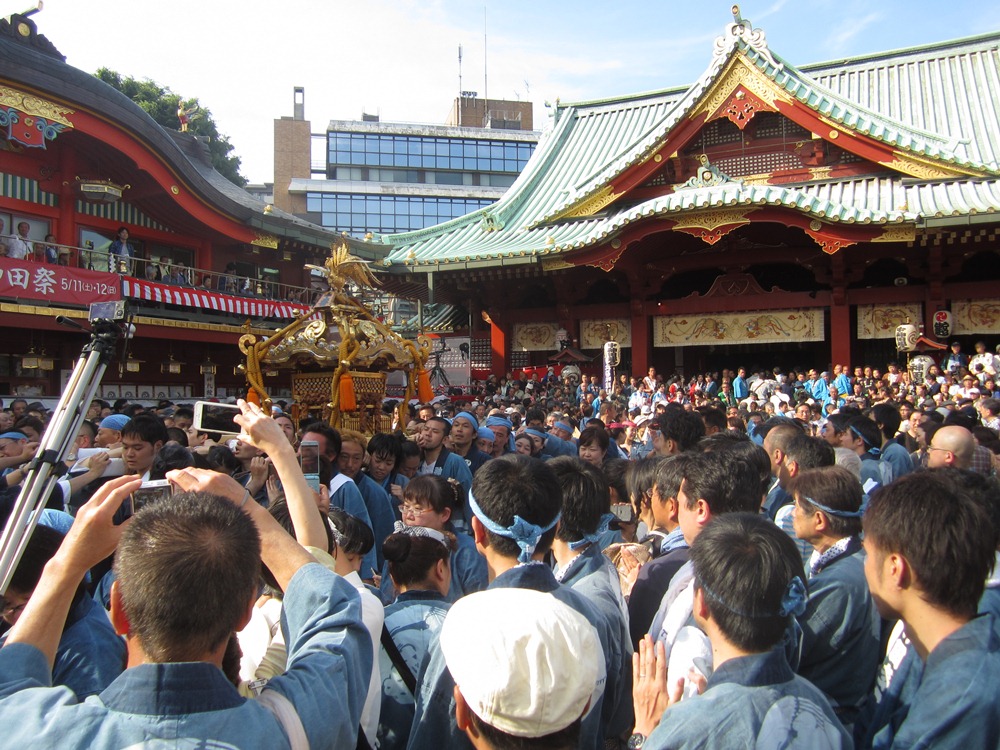
It is often said that Tokyo’s summer starts with Kanda Festival. Today was the last day of the Festival and I visited there. It was a clear and hot day.
The festival originally started as an event of Kanda Shrine. It became popular in the Edo era. It is now held every two years. As 2011’s festival was suspended because of the Great East Japan Earthquake, this year’s festival was first in four years.
Tens of mikoshi (portal shrine), carried by members of communities in the are, moved around the shrine. People were in happi or traditional costume.
Thousands of visitors watched the performances in the shrine and on the street in the area.
Kanda Festival is counted as one of Tokyo’s three major shrine festivals (other two are Asakusa’s Sanja Festival and San-no Festival of Hie Shrine). It is also counted as one of Japan’s three manjor festivals (other two are Kyoto’s Gion Festival and Osaka’s Tenjin Festival).
2013-05-05
Tokaido walk(26) Okehazama-Miya (off Tokyo): May 5, 2013
It is not too much to say that early modern Japan started from Owari (current western Aichi Prefecture) and Mikawa (eastern Aichi). Three heroes of the country's history -- Oda Nobunaga, Toyotomi Hedeyoshi and Tokugawa Ieyasu -- who reunited Japan and ended the middle age in the late 16th and early 17th centuries were born in the area. Many historically important events took place here.
I started today’s walk from Okehazama. A historical battle took place in 1560. With its surprising victory over Imagawa Yoshimoto, Oda Nobunaga started the process of unification of Japan (and partially realized before his death).
We find many monuments and historical places in the area. The sculptures of Oda Nobunaga and Imagawa Yoshimoto were placed in a battlefield park. The inscription told “the birthplace of early-modern Japan”. In other park, Imagawa Yoshimoto’s tomb was built. I saw several volunteers giving guide services to visitors.
I moved into Nagoya City. My first stop was Arimatsu, an interim station between Chiryu and Narumi. The place is famous for its dyeing textiles named “Arimatsu shibori”. Traditional houses from the Edo era are reserved.
I passed Narumi, the 40th shukuba station from Nihonbashi, and arrived at Miya, the 41st station. People rode on boats here to move to Kuwana, the 42nd station in the Edo era. A lighthouse and other facilities remained in the port.
Famous Atsuta Shrine is near Miya shukuba station. The shrine enshrines Kusanagi sword, a symbol of Emperor’s power in old Japanese legend. It has 1900 year history according to the legend.
Miya shukuba station is about 360 kilometers from Nihonbashi, Tokyo.
Tokaido Walk(25) Okazaki-Chiryu (off Tokyo): May 4, 2013
Aichi is historically important as it was the birthplace of Oda Nobinaga, Toyotomi Hideyoshi and Tokugawa Ieyasu, three heroes of Japanese history who opened the door from the middle age to the early modern period.
Aichi is famous today for its manufacturing and agriculture. Toyota Motor has its headquarters and many factories in Aichi. Many auto-parts makers and other manufacturers have offices and factories here. They produce many vegetables, dairy goods and other agricultural products here.
Today’s walk started from Haccho-cho, western part of Okazak. It is a home land of Haccho miso, a special fermented soybean paste. It has been produced for nearly 350 years. Old buildings of the Edo period also remain here.
Some factories are open for public and I visited Kakukyu’s factory. There were many big barrels in a warehouse building. Miso was in the process of fermentation in them. Other barrels were being dried outside the warehouse. Miso soup was served after the tour.
I walked westward and arrived in Anjo City. The city is called “Japan’s Denmark” as it has developed daily industry. Vegetables are also produced. Fresh farm products were sold at a market.
A festival of Kakitsubata (Iris laevigata) was held at Yatsuhashi area in the city. A famous legend of Ariwara no Narihira, a waka poet in the 9th century, was linked with the area.
There were many factories along Tokaido. Lines of old pine trees continued in front of some factories. I also saw the fields of wheat and other agricultural product along the street (2nd photo).
I passed Chiryu, the 39th station, and crossed Mikawa-Owari border. Huge power transmission towers stood here. I continued my walk to Okehazama, an old battlefield.
Tokaido Walk (24) Akasaka-Okazaki (off Tokyo): May 3, 2013
I started today’s walk from Akasaka, the 36th shukuba station for Fujikawa. It was hilly in the area. Tokaido and Tomei Highway as well as Meitetsu Railway run in parallel through mountains and hills.
Maintenance and renovation works have been made in the last decades here. New pine trees were planted along the street. The works were done as parts of “Tokaido Renaissance Project.”
Wheat and barley fields spread in some parts in the area. Farmers just started planting of rice this week. I heard the sound of flogs and birds here.
I moved westwards and arrived in Okazaki, the 37th station. Tokugawa Ieyasu, the founder of Tokugawa Government was born in Okazaki castle. He ruled the land from the castle about 10 years.
Many corners were around the castle to defend it from opponent’s attack. The case of Okazaki was more than usual. It had 27 corners. Now, sign boards are placed in each corner.
The city also places the Edo era-related sculptures in many places along Tokaido to attract visitors. The picture shows the image of waitress in the inn.
2013-05-02
Tokaido Walk(23)Toyohashi-Akasaka: April 29, 2013
I continued my Tokaido Walk from Yoshida (Toyohashi City), the 34th Shukuba station, through Goyu to Akasaka, the 36th.
I walked westwards about 10 kilometers. There were “ordinal scenes” of Japan along the street in the area. I saw residential houses, factories, shops as well as agricultural fields during my walk.I arrived in Goyu, the 35th street. It was a small shukuba station. Old fashion buildings remained in the area.
I arrived in Akasaka shukuba station within 15 minites after leaving Goyu pine trees. Old atmosphere also remains here. There is an old inn named “Ohashiya”. It has received guests since the Edo era.
2013-04-30
Tokaido Walk (22) Hamamatsu-Yoshida: April 28, 2013
It was again a nice day for walking. I had a long walk.
I started Hamamatsu, the 29th shukuba station, passed Maisaka, Arai, Shirasuka, Futagawa stations, and arrived in Yoshida station in Toyohashi City. Sic shukuba station in one day is the largest in my walking. The finished my walk in Shizuoka Prefecture and moved in Aichi Prefecture.
Maisaka, the 30th station, locates at the east side of Lake Hamana. Historical buildings remain.Pine trees are planted at the sides of Tokaido.
People passed Lake Hamana by boat in the Edo era. Now, roads connect east and west of the lake. Lake Hamana was separate from the sea until about 500 years ago(It was a fresh-water lake). It was linked with the sea after a big earthquake in 1498.
A shrine was built in the sand island in the lake. People enjoy fishing both from the land and on the boats.
I walked westward to Shirasuka Shukub station. The station originally located at the seaside. The station was completely destroyed by tsunami disaster in 1707.
The shukuba station was rebuilt on the hilltop after tsunami disaster in 1707. I climbed the slope and found the sea spread under the slope.
I passed Shizuoka-Aichi border. Agricultural fields spread along Tokaido. Old buildings remained in Futagawa, the 33rd station.
Today’s goal was Yoshida, the 34th station from Nihonbashi, Edo.
Subscribe to:
Posts (Atom)