2015-08-11

Cyprus: August 5-7, 2015


It took about two hours by plane from Greece to Cyprus. Geographically, it is nearer to the Middle East (Syria, Egypt etc.) than to Europe. The country is however a member of the European Union.

It had a financial crisis in 2012 and 2013. The economy started to recover, with the help of the EU, and it recorded the first positive growth in the first quarter (January- March) in 2015 after the crisis.

I only visited Nicosia and some other places and it was hard to find the aftermath of the crisis.

The highway from Larnaka Airport to Nicosia was well developed. The number of the automobiles was relatively small.

It was so hot. The temperature went up over 40 degrees. It was extraordinary for the country.

Nicosia has been divided into two parts since 1974. The southern part of the island is ruled by Greek residence while the northern part is inhabited by Turk people. Nicosia is the last divided capital in the world.

I walked along the border in southern Nicosia. The roads were blocked by barriers. (see also the top photo).


I found the “Berlin Wall No.2” cafĂ© at the side of the border. 


I also found a design in the caps of sewage holes which symbolized the divided city. (see also the 2nd photo from the top).

There is a check point through which we can go up and down between the southern part and the northern part of the city. 


Each Greek and Turk administration has its gate. The left picture is Turkey-side gate.

There is a space which is managed by the U.N. between the two gates. 


The border is called the “Green Line”, which runs through not only Nicosia but also the whole island. The total length is about 300 kilometers. About 800 U.N. soldiers guard the line.

The atmosphere of the two parts was quite different.

The shopping streets in the southern part of Nicosia are modern. They were full of foreign tourists. Historic place such as Byzantine Museum were well arranged.

I found many mosques in the northern Nicosia. 


The streets and the shops looked older than those in the southern part.

I also visited mountainous area in the central part of the island. 

Many villages are trying to attract people with “agro tourism”. 


They sell local products.
The landscape was beautiful.


Greece (2) Acropolis, islands and other must-see places: August 2-4, 2015


It is needless to say that Greece has many attractive places for tourists. I really enjoyed my walks in the country.

Acropolis is the highlight of the sightseeing in Athens. The Parthenon, the masterpiece of the ancient Greek civilization and a symbolic birthplace of the western civilization, stands on the hill. I was strongly impressed.

The old Dionysos theater was at the foot of the hill. Other temples and gates remained. The sky was blue and the temperature was high. I walked around the hill in the shower of the cicada sounds.

I got good information of the Acropolis as well as the ancient Greece at the new Acropolis Museum, which opened in 2009.

I also visited the Agora, the market and the citizen’s gathering place in the ancient times. It is near the Acropolis. It was interesting for me to imagine that Socrates and other philosophers made speeches here.

There are many ancient buildings in the city. The Hadrian’s gate and the Temple of the Olympians Zeus are examples.

The Parliament stood in front of the Syntagma Square. People gathered there to see the exchange of the guards is performed in every hour.

The Plaka district remains old atmosphere. I enjoyed window shopping and the tea there.

I also joined a cruising tour in the Aegean Sea and visit three islands, the Hydra, the Poros and the Egina. The sea was beautiful and the towns were lovely.

People do not use automobiles in the Hydra island. They instead use donkeys and horses there. (see the photo 2nd from the top).

The Poros island locates near the Peloponnese peninsula. Wind power generators were placed on the mountain top.


Greece (1) Society and Economy:August 2-5, 2015


It was less than a month ago when Greek Crisis was at the center of attention in the world. The events such as a chicken race with the EU on the bailout negotiation, the abruptly announced referendum, a sudden agreement, made headlines in the international news.

I visited the Athens, the capital of the country.

The town was calmer than I had expected before my visit. It is reported that the country’s unemployment rate is more than 25% for all working ages and nearly 60% (surprising!) for young generation. The figures are as high as those in the U.S. in the early 1930s, the time of the Great Depression.

The town looked normally working. The metro, the buses and the taxies ran without any serious problem. There were many foreign tourists in the city. The restaurants and souvenir shops in Plaka and other popular places for tourists were crowded.

Still, I found some homeless people lying in the sidewalks. Some of them were just near the automated teller machines, which had recently restarted normal operation after having limited the amount of withdrawal. However, I did not find the number of the homeless people were fur much more than the number in Tokyo.

I found many dogs lying in the ground near the Syntagma Square, the center of downtown Athens. It is nothing to do with the economic crisis. They do so as it is hot.
I also found lots of graffiti on the walls in many places in central Athens. 


Many of them were drawn for the referendum. (see the top picture).

I also visited the cultural area near Athens University and the National Technical University of Athens. Many far-left activists as well as anarchists live in the area, according to a local person. The graffiti looked having been drawn far before the referendum.

The infrastructure, including airport, metro and highways, looked far better than decades ago.

The Athens stock exchange resumed its operation on April 3rd (during my stay). The index dropped about 16% compared with the level of June 28th when it was closed.

The hottest news among the Greek people at the moment was the increasing refugee from the Middle East through Turkey into the country (especially to the Lesvos, Kos and other islands which locate near Turkey), not the economy. 

The function of the families (along with other mechanisms) might be working as safety net of the society under such high unemployment rate, according to a local friend.

On my arrival at Athens, I was welcomed by a message board of a bank at the airport. It said "the most forward-thinking banking...”. Many foreign visitors laughed at the board. I was one of them.


2015-07-24

Building Construction @ Marunouchi, Otemachi:July 20, 2015


Marunouchi locates in the very center of Tokyo. It it includes the Tokyo Station. It is one of Tokyo’s largest business centers. 

Neighboring Otemachi is similar. Many big businesses have their headquarters in the areas. (top photo)

They are very crowded with people and automobiles in the weekdays. Watching the scenes of the districts is not comfortable from Monday to Friday.

I had a walk in the areas today as it was national holiday and the districts were not so crowded.

Construction works were underway in many places. I found at least five constructions in about 10minute walk from Otemachi to Marunouchi.

Japan’s loose-money policy is one of the reasons which created the construction boom. Another reason is the expectation for the 2020 Olympic and Paralympic games.


The scene of the area is changing.

2015-06-28

Horses & Kids @Baji Park: June 28, 2015


Tokyo enters into the rainy season. We try to find the opportunities (between the rain) to go out.

Today, I visited Baji Park Equestrian Park.

Children were given an opportunity to be close to the horses and to touch them.

The horses were will trained and gentle. Kids as well as their parents enjoyed touching the horses.


2015-06-21

Tax free shops@ Shinjuku: June 21, 2015


The number of Asian tourists is increasing remarkably in recent years. More than 13 million foreigners visited Japan in 2014. The number will surely be more than it in 2015. Many of them enjoy shopping in Tokyo.

I visited tax-free shops in Shinjuku.

Laox, a Chinese capital-backed firm, opened a new shop in Shinjuku early this month. The store sells goods including electronic goods, cosmetics, luxury watches, jewelries, and fashionable clothes. All commercial goods are duty free, that means the store target foreign tourists.

There were not so many shoppers probably because the store was just opened. The sales staff seemed to bhave been trained well. The Chinese staff spoke good Japanese.

Bicqlo is a shop operated by Bic Camera and Uniqlo. It opened in 2012. Each company has its sales spaces in the building. They target both Japanese shoppers and foreign tourists. Tax-free services are offered for foreigners (top photo).

The store was crowded. Japanese, Chinese and other Asian languages were heard in the shop.

The “massive purchase” by Chinese and other Asian tourists makes headlines of newspapers these days. Stores are making efforts to take in it.


2015-06-01

Various scenes in Kawasaki City: May 31, 2015


Kawasaki City, which locates between Tokyo and Yokohama, has many features. Its population is about 1.5 million. It developed as an industrial city after the Meiji Revolution, became infamous as a city of air pollution in the 1960s and 1970s and introduced pollution control policies in the past 40 years.

It has industrial zones in the eastern coastal areas and residential districts in the north. It has many high-class residential areas, but some areas are left behind modernization. There still remain the areas where many flophouses stand.

There was a big fire in mid-May at flophouses and several people were killed. The fire site is about 15-minute walk from JR Kawasaki station. I visited the place to mourn for the victims and to see the situation of the area. (top photo)

The buildings were burn out. The smell of ash dust still remained. Modern apartment houses stood around the site.

There are many flophouses in the area quite near from the fire site. Many old people stay there. It is reported that many of them live on the public livelihood assistance. (the 2nd photo)

I also visited Ukishima Park, which lies at the mouth of Tamagawa River. The park is in the industrial zones. 


There are factories of petrochemical, electronics and other fields there.

The Tokyo International Airport (Haneda Airport) is at the opposite side of Tamagawa River. The airplanes took off and landed in every two or three minutes.


2015-05-17

Econ town & Beach @Fujisawa: May 10, 2015


The energy policy is one of the most important policies in Japan. The questions over the nuclear energy are repeated. The options to reduce the greenhouse gases are discussed. The efforts to increase the renewal energy are being made.

I visited the “Smart town” in Fujisawa City. It opened in 2014. One thousand houses are built and there are about 3000 residents. Solar panels are attached on the roofs.

Solar panels are also placed in several public places.

Similar efforts are made in many other places.

I also visited the seaside area of the city. 

It was a hot sunny day and there were many people enjoying surfing, beach volleyball and the sun bathing.


Enoshima, a small island off Fujisawa, was crowded with tourists.

2015-05-10

Tokaido Walk (33) Otsu-Kyoto (off Tokyo): May 6, 2015


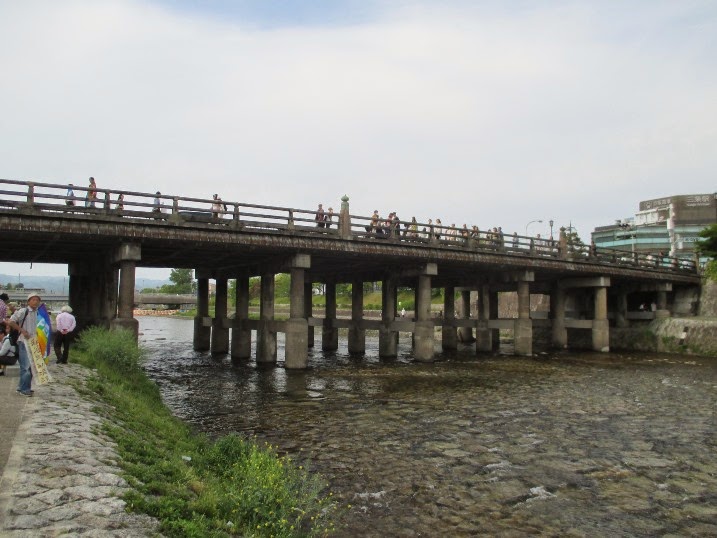
This is the last session of my Tokaido Walk. I took the first step from Nihonbashi, Tokyo, in 2010, stopped all 53 shukuba stations, and arrived today at Sanjo Ohashi Bridge in Kyoto.

I started today’s walk from Otsu, the 53th shukuba station.

I climbed Osaka-no-seki or the Osaka Pass, which lies between Otsu and Kyoto. The road is steep. 
The road used to be covered with stones in the Edo era so that the animal-run carriage could move smoothly. The monument of the pavement remains.

There are so many historical places alongside the road. They included Semimaru Shrine, which worship a legendary biwa (Japanese music instrument) player in 9-to century.

I also visited the tomb of Emperor Tenji in the 7th century. The history of his age is full of mystery.

It was the public open day of the drinking water filtering plant at Keage in Kyoto’s east area. The place is also famous for azalea.

I dropped in Chion-in Temple, the head of Buddhism’s Jodo sect and Seiren-in Temple before arriving at Sanjo-Ohashi Bridge, the walk’s goal.

The total distance was about 500 kilometers. 

I did it.
Goal !!!
The statues of Yaji-san and Kita-san, famous imaginary characters who traveled the Tokaid road about 200 years ago, were waiting me.

I am happy to meet you here !