2017-02-12

Ume Blossom: February 11-12, 2017


Ume (Japanese apricot) stated to blossom.

I visited Hanegi Park in Umegaoka. There are more than 600 ume trees in the park.

They opened white and red flowers. It smelled well.

There were lot of visitors. They took photos of the flower.

The Ume festival was held at the season.

Families enjoyed picnic there.

I also visited Gotokuji temple.

Several ume trees opened flowers in the garden. (see also the top photo) 


2017-01-26

Mount Fuji (off Tokyo): Jan.7-22, 2017


I had occasions to visit Shizuoka Prefecture. I could enjoy various scenes of Mt. Fuji from towns and through the window of Shinkansen Bullet train.

It is a scene from Shinkansen in Fuji City. Mt. Fuji stands behind the rice field, the tee garden, towns and factories. (see also the 2nd and 3rd photos from the top) 

Mt. Fuji over the Fujikawa River is wonderful. (See the top photo)

The scene is from Odawara, Kanagawa Prefecture. It is the eastern side of Mr. Fuji.

The southeastern side of the mountain is seen from Mishima, Shizuoka Prefecture.


2017-01-24

New year’s visits to shrines and temples: Jan.1-4, 2017


A new year began. I visited shrines and temples to make wished for the coming year.

Rokusho Shrine is a small shrine in Setagaya ward and it is usually uncrowded.
On January 1st, I saw many people in a queue to make prays.

Gotokuji Temple was also crowded on the same day. (see also the 2nd photo from the top)
The temple is famous as a place where the lucky cat legend was made. Many lucky cats are placed here after being used as the guards of the houses and stores. People not only prayed at the temple, but also made visits to the lucky cats.

Yoyogi Hashiman Shrine in Shibuya ward is one of popular shrines in Tokyo. I visited there on January 3rd. (see also the top photo)
People made a long line.

I also visited Setagaya Hachiman Shrine. A photo place was arranged for the visitors.


I got a feeling that the number of new year’s visitors to shrines and temples are increasing year by year. It may be because the number of old people are increasing. I am not sure.

2016-12-29

Military bases and war history in Okinawa: Dec. 28-31, 2016


It is not possible to talk about Okinawa without referring to the U.S. military bases in the islands. It is also not possible to know Okinawa without understanding its history, especially the tragedy of the Okinawa battle during the World War 2.


I moved around the main island and watched the bases, stations, camps, and other related facilities of the U.S. forces as well as the memorials of the Okinawa battle.
There are more than 20 bases and other facilities in the Okinawa main island. They occupy about 20% of total area of the island.

Futenma Marine Corp Air Station is often said to be the “most dangerous military airport” in the world. It locates in Ginowan City, about 7 kilometers north of Naha, the prefecture’s capital. About 100 thousand people live in the city.

The Futenma station lies in the very center of the city. Thousands of houses stand around the station.


The planes fly very low over the residential houses. There was a crash accident in the neighboring university in 2004.


I could see the whole view of the station and the houses around it from a hill nearby.


I found about 20 Osprey planes deployed in the station. The plane, officially called the Bell Boeing V-22 Osprey, is a multi-mission, tiltrotor military aircraft. The deployment of the plane is a matter of controversy in Japan on is safety and other issues. (See the top photo)

Many people were there to watch the station.


I also visited Kadena Air Base, about 10 kilometers north from Futenma. The base has two 3700 meters-long runways. It is the largest U.S. air base in Asia.


We can see the base from the upper floor of the Michinoeki Kadena, a commercial facility which stands at the side of the base.

Many cameramen and other people were watching the base when I visited Michinoeki Kadena.


I watched takeoffs and landings of various kinds of airplanes, ranging from fighters to cargo planes and Ospreys. Th takeoff took place every five minutes. (See the 5th photo from the top)

I heard the planes making big sound. It continued overtime.


Kadena Air Base lies in two towns and a city (Kadena Town, Chatan Town and Okinawa City). It has not only military facilities but also residential areas, schools and sports facilities. One of the gates is in Okinawa City. 


Camp Hansen has huge training areas. Its main gate is in Kin Town.

There spread commercial and entertainment districts in front of the main gate. The U.S. soldiers drink, eat and play in the districts. (see the 4th photo from the top)

A restaurant in Kin Town started to serve taco rice, a rice bowl with tacos ingredients decades ago. It has become popular. Kin Town is now known as the birthplace  of Taco rice.

The soldiers used much money in the town at the time of the Vietnam War in the 1960s and 1970s. Now, they spend longer time in the camp and use less money in the town.  Some stores closed their shutters.
I visited Henoko in Nago City. It is in Camp Schwab. 

The beach and the sea are beautiful in the area (See als the 2nd photo from the top).


We have a big dispute in Japan over Henoko.

Japan and the U.S. agreed to close Futenma Station and to move its facilities to Henoko in 1996. They plan to build two runways and other facilities in the seashore areas. There arose a movement to oppose to the plan.
There have been political zigzags in the last 20 years. Current Okinawa Governor Takeshi Onaga opposes to the plan and  has judicial battles with the national government while keeps talks with them.

Views are divided in Okinawa and even in Henoko. People in the small village used to live on fishery. Some of them are now forking for Camp Hansen.

Dugongs live in the area.They will not able to live once the facilities are made.


The government started the construction works in December after the Supremo Court issued a judgement which support the government (in a case). Those who oppose the construction took actions such as demonstrations both on the land and in the sea. There was few such moves when I visited there as it was new year's eve.

There was a hanging curtain to appeal to oppose the construction. (See the 3rd photo from the top)

I saw several tents of the group who oppose to the plans in front of Camp Schwab's gate.


The Himeyuri monument is quite near from the southern seashore. The monument console the soles of the people including young girls, who were forced to work as nurses with the imperial forces in during the Okinawa battles in the World War 2 in 1945, and eventually were killed or forced to commit suicide when Japan lost the battle. (See the 6th photo from the top)

The nearby museum explains the details on what happened. I was sad to know their tragedy and was furious with the irresponsible policies of the political leaders then. The origami cranes were devoted to them.


I also visited the Japanese Navy Underground Headquarters. They fought here against the U.S. forces before the commanders committed suicide in June 1945, about two months after the U.S. forces landed Okinawa on April 1st of the year.


A photo of the landing was displayed. Around 150 thousands Okinawa people were killed in the war. Okinawa's population at the time was 600 thousands.


Life and society in Okinawa: Dc. 28-31, 2016


During my stay in Okinawa, I saw various aspects of people’s lives and society of Okinawa.


Naha’s Kokusai Dori street is the busiest shopping area in the city and in Okinawa. Pine trees are planted in the sidewalks of the 1.6 km street. Souvenir shops sell traditional crafts as well as interesting goods with new ideas. Restaurants serve local foods and Okinawa music shows.


There is a public market near the street. Tens of meat and fish traders hold their businesses there.

I saw so many Chinese, Taiwanese and foreign tourists in the street and market. Some shops have duty-free corners to attract foreigners. I met many fish traders who spoke native Chinese in the market.

Tourism is a major industry of Okinawa. One of the most rapidly developing areas is increasing foreign tourists. I recognized the trend.

Okinawa is famous for its sugar cane. I saw sugar cane fields in many places. 

They have flowers at the top in the season.
(See also the photo 2nd from the top)


The harvest has just begun.

Many musics are made on the sugar cane. Some of them bring the memory of the war in them.


Many other vegetables are grown in Okinawa. I saw some of them at a farmer’s market in Itoman, southern neighbor of Naha. “Made in Okinawa” was stressed.


They also sold small dishes of sea food in the neighboring fish market.

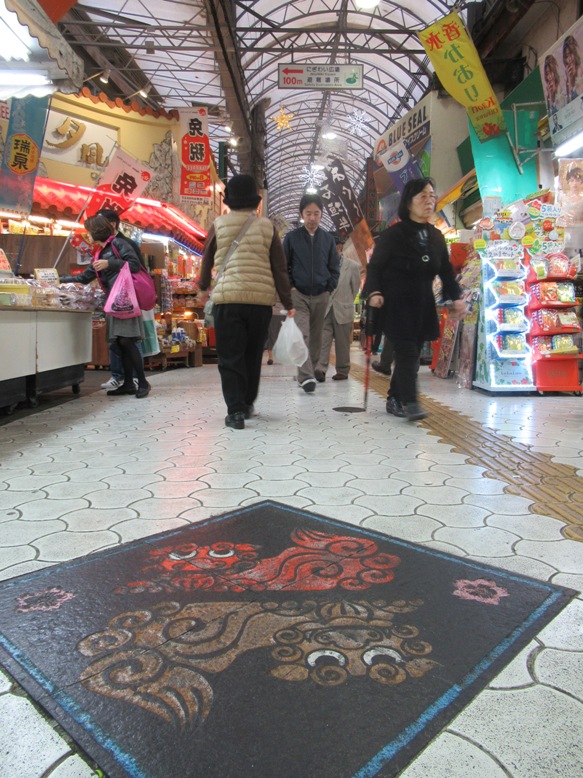
Shisa, lion-shape decorations, are found everywhere in Okinawa. It is believed to guard people from evil spirits.

Some of them are sculptures and some are painted. They are on the top of the roofs, at the gates of the houses and shops, on the roads and in the showcases of the stores.

I found a paint of Shisa in the market street near Kokusai Dori (See the 3rd photo from the top).


Most new houses are concrete-made to prepare for typhoons. They have water tanks on the floors as Okinawa had water shortage till a decade ago.

Tomb is important in Okinawa as they keep the tradition of ancestor worship. I saw many big and decorated tombs along the roads. The relatives gather at a tomb to pray for their ancestors in spring. 
People especially enjoy music and dances here. The restaurants hold Okinawa song performances in many restaurants every night at Naha’s Kokusai Dori street and in other areas. Okinawa’s song is accompanied by sanshin (three string) guitar. Eisa dance is performed in many places.

School boys and girls widely learn dancing, playing the sanshin, and other traditional performances. Private dancing school is also popular. I found groups of such kids showing their performance in the American Village shopping complex in Chatan town, north of Naha. (See the top photo)