2011-09-28

Urayasu:Sept 24, 2011


Urayasu City, eastern neighbor of Tokyo, is famous as a home town of Tokyo Disney Land.
But the city made headlines in different sense. Many places in the city were liquefied, which made headlines after the Great East Japan Earthquake in March.

About three quarters of the city’s land were reclaimed after the 1960s. That was the cause of wide liquefaction.


The damages of the earthquake still remain here and there.

I found many holes, gaps and cracks in the pavements when I walk around the city. The grounds in the city sports center were still out of use as repair works were still necessary.


Old Edo River flows between Tokyo and Urayasu. Buildings stand at both side of the river. Fishing boats went up and down.

2011-09-18

Sendai, Ishinomaki@Tohoku; Sept 17-18, 2011


Six months have passed after the Great East Japan Earthquake and tsunami disaster. I visited Sendai, Ishinomaki and other hard hit places in Miyagi Prefecture, Tohoku district. It was a painful visit.


People’s life seemed to have returned normal in the central part of Sendai, Tohoku’s largest city with a population of one million. The damages of the buildings and roads are being repaired. I saw people enjoying shopping in the malls.


The coastal areas were quite different. I walked about 10 kilometers from Sendai railroad station to Arahama area, which was washed out by tsunami.


Destroyed cars and other rubbles remained in the fields. Crane cars and other construction vehicles were working to dispose them.

They grew rice in the fields lasy year. They were covered by Japanese silver grass today. The rice is not expected to grow for several years as the soil is still salty.


Only the cement bases left at the places where houses stood before the disasters.

There stood a destroyed gas station along a main road. The inclined polls showed the strong power of tsunami.

I visited Arahama elementary school which licates about 300 m from the sea. Anout 200 people escaped onto the roof of the school just before the tsunami. They were rescued day after.


Now, the school is closed and motor bicycles and other things left behind were placed in the ground.


Ishinomaki is about 40 kilometers east from Sendai. The city was most seriously hit by the quake and tsunami. More than 5000 people were killed or missing.

Many houses in the coastal area and riverside were washed out. Some boats were still on the ground.


The city hospital in the harbor area was abandoned. The neighboring drugstore was in the water.

No one was there. Only the sound of wind the singings of insects were heard.


The land sank down by maxmum 80 centimeters after the quake. Many parts are under the water. Sandbags were piled up here and there.
Thousands of abandoned automobiles were plied up. A mountain of rubbles was also seen.

Many shops and restaurants were seriously damaged and closed. Traffic policemen controlled the cars in the corners as the signals were still out of order.


People's lives seemed to be hard. I was a bit released when I saw people having walks with their dogs and having chattering on the bank of old Kitakami River.


I also visited Matsushima and Shiogama, both locate east of Sendai.

Matsushima is famous for its beautiful seaside scene. The town itself was not so seriously hit by tsunami as the island in front of the town prevented the waves (The islands were heavily damaged). Many tourists were here.


The sea moss and oyster were seriously damaged in the Matsushima and Shiogama bay.

2011-09-16

Kabuki@Shinbashi Enbujo Theater: Sept 11, 2011


I


 usually visited Kabuki-za Theater in Ginza to see Kabuki. (see July 22, 2009 article)

Today, I visited Shinbashi Enbu-jo theater as Kabuki-za is now under construction.


The theater is three-story structure and has 1428 seats. Music, dance show and other performances are played besides Kabuki in the theater.


Today’s programs included a succession ceremony of traditional Kabuki names (Nakamura Matagoro and Nakamura Kasho). Leading Kabuki actors including “living national treasure” Nakamura Kichi-emon and Sakata Tojuro attended the ceremony.

Belgium Beer Weekend @ Roppongi Hills: Sept. 9, 2011


I used to live in Belgium, so Belgium Beer weekend is a “must go” event for me.

This year’s event is held from September 8th to11th at Roppongi Hills.
They serve various kind of Belgium beer and some Belgium foods such as frits. Belgium beer is becoming more and more popular in Japan in last 10 to 20 years.

The terrace was crowded with hundreds of people when I arrived. I needed to wait more than 10 minutes to buy tokens (which is used to buy beer and foods in the event area) and another 5 minutes to get my beer.


Japanese as well as foreigners were there. Most of them looked young. It was Friday night.


The organizer expected to attract more than 18 thousands visitors in four days.

2011-08-27

Tokaido Walk(15) Ejiri-Fuchu: August 27, 2011


Hot summer will soon be over (hopefully). I restarted my Tokaido Walk.


I walked from Ejiri, the 18th shukuba station from Nihonbashi, to Fuchu, the 19th.


Ejiri is in Shimizu Ward in Shizuoka city. The town is famous for its port. They have developed such industries as fish food production, wharehouse, transportation and marine related machines. It also boasts its football team (Shimizu S-Pulse), Jirocho, one of the nation’s most famous chivalrous heroes in the 19th century, and Chibi Maruko, a cute manga heroine.

Some buses are painted with Chibi Maruko-related characters.


Kusanagi, between Ejiri and Fuchu, is historically famous. Yamato Takeru, Japan’s legendary hero in the country’s founding era (about 2000 years ago), had a famous fight here. A shrine is built to commemorate the event.


Houses spread along Tokaido here. I also found many horticulture farms here.


2011-08-13

Sri Lanka(3) Nature & Animals (off off Tokyo): August 7-12, 2011


I always find animals during my 1 week stay in Sri Lanka.

I enjoyed safari 3 times.


My first safari was at Minneriya National Park near Polonnaruwa in central Sri Lanka. The park is famous for elephants.


I found about 100 elephants gathering around water pools (for drinking water and taking bath).

Some group came out of bushes and moved through safari jeeps into green fields.  Baby elephants ran hard to follow adults.

It was so impressive.


My second safari was at Yala National Park in south east coast. It was famous for peacocks. Hundreds of them were walking elegantly.


I also saw buffaloes, wild hugs, deer, crocodiles, mongooses and other animals and birds.


I also enjoyed a boat safari at Ahungalla, south west coast. My small boat moved through a mangrove jungle. Birds flied over the trees. I was surprised when I found big water lizards, which were around 1.5 meter long, swimming in the water.


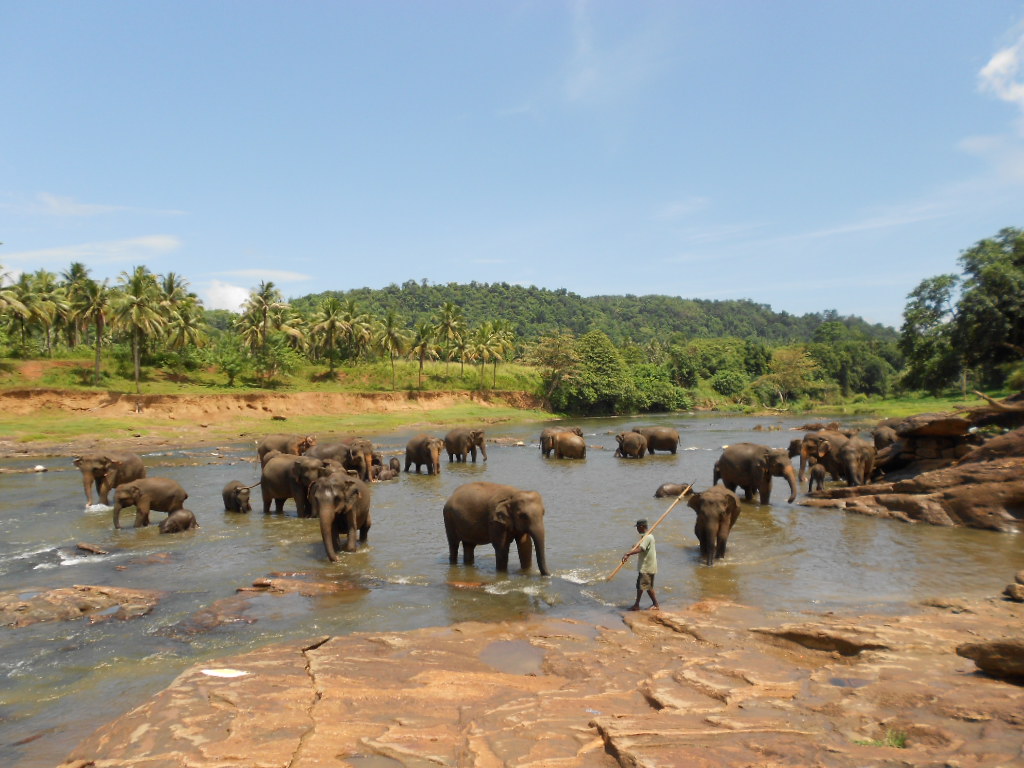
Another impressive experience was a visit to elephant’s orphanage at Pinnawala near Kandy. Around 100 elephants are cared at the center.


The elephants are taken to a nearby river twice a day for bathing. They walk in a public road on the way to and from the river.

People and dogs were also on the road when I arrived there.


Marine turtles are also cared in a protection center near Bentota, east coast city. Baby turtles were swimming in pools. Children enjoyed seeing (and sometimes touching) them.

They will be released to the Indian Ocean soon.
Only one turtlr out of 100 will grow up and return to the coast, acording to a staff member.

I saw dogs and cows everywhere (including in the public roads and fields) in the country. Even elephants walkes in the road.


I also found monkeys and squirrels in some places.


The Indian Ocian was beautiful. The sea was blue and the palm trees covered the coasts.


The waves made heavy sounds and I felt vibrations when I was sleeping in a sea-coast hotel.

Sri Lanka(2) Culture & History(off off Tokyo): August 7-12, 2011


I could have an opportunity to Perahera festival in Kandy during my stay in Sri Lanka. I was lucky.

Perehera started as a local festival to cerebrate local gods about 2000 years ago. But it was connected with Buddhism Temple (Temple of the Tooth) and became a nation’s important event in the 18th century.


The festival continues two weeks every year. Hundreds of elephants and dancers walk across the streets and show their performances.


The performance was scheduled to start in the evening, but thousands of people were already waiting on the road sides when I arrived Kandy in early afternoon.

The march and performance continued about three hours. The elephants moved in order, which was a big surprise to me.


I visited all six world cultural heritage in Sri Lanka. They are:

Sacred City of Anuradhapura


Sri Lanka's first capital (BC 380-AD century). Became World heritage in 1982.

Famous bodhi tree (lime tree) is planted. Buddha attained enlightenment under a tree in Buddha Gaya in northern India in the 4th cantury B.C. The branch of the tree was imported into Sri Lanka in the 3rd century B.C. and was planted here. The original tree in India has already been dead.

There are also histrical important stupas in the city.


Ancient City of Polonnaruwa

Sri Lanka's second capital (10-12 century)
Famous Buddha scalptures are curved in a hige rock. The lying one is 14 meter long.


Sacred City of Kandy

Sri Lanka's 3rd and last capital(15-19 century)
Perahera festival is held here. Temple of the Tooth keeps Buddha's tooth.


Ancient City of Sigiriya

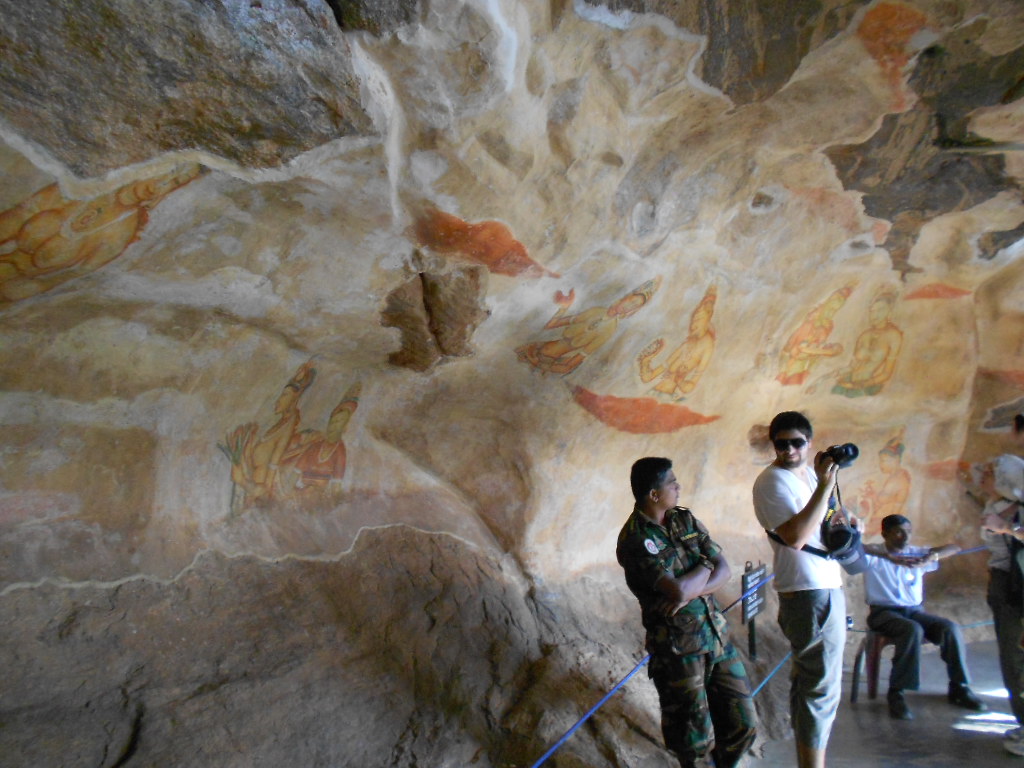
Sigiriya is the ruin of a rock fort (or Palace) in a jungle. It was a tenporal capital of the country (only 11 years) in the late 5th centyry. The history of Singiriya is connected with a tragic (mad?) king.


King Kasyapa killed his father and became a king and moved tha apital from Anuradhapura to Singiriya. But he was later defeated by his brother and killed himself.


The palace was decolated with beautiful paintings. The pictures of half-naked women are especially famous.

Only 18 paintings out of about 500 remain.


Golden Temple of Dambulla


There are five temples in a stone mountain in Dambulla.


Old Town of Galle and its Fortifications

Galle originally developed as a port to be used for trades with Arabic people. Portuguese established a fort in the late 16th century. The fort was controlled by Dutch people in the 17th centyry. The ruler changed to British later.


The indian Ocean spreads in front of the fort.

Sri Lanka(1)Life & Society(off off Tokyo): August 7-12, 2011


I visited Sri Lanka to enjoy my summer vacation. It was my first visit of the country.

The country has 8 world heritages. It also attracts tourist with its beautiful beaches and rich nature. It is true, but I was also interested in its society and people’s life.


The country is still poor. Its per capita income is still about $ 2000 (2010 estimate). It does not have highways. Roads are dusty and bumpy.


Traffic signals are rarely seen even in big cities like Colombo.
Three wheelers run amid automobiles. They are main players in transportation in rural towns and villages. Dogs and cows walk in the streets.

Rural areas do not have electricity. People shop at old local markets.


It seemed that the civil war (1983-2009) had seriously hit the economy and had delayed the developments of the society.


Still changes are seen.

I found mobile-phone billboards and shops everywhere in the country (even in small mountainous villages). Cell phone is becoming "must" thing for people and even elementary school boys and girls held them (taking them to school is banned), according to my tour guide.


The country is green rich. Water is also affluent.

I saw coconut palm trees field in various places.

Growing rice is popular in lowland.


Tea plantations spread in moutan areas. I visited Mackwoods tea plant near Nuwar Eliya. The plantation was developed by William Mackwoods in the mid 19th century. I was impressed with his venture spirit (along with colonization history).

Herb plantations are also developed in mountain areas.


I saw many posters of political parties and politicians in the towns. President's poster is mostly stand out.


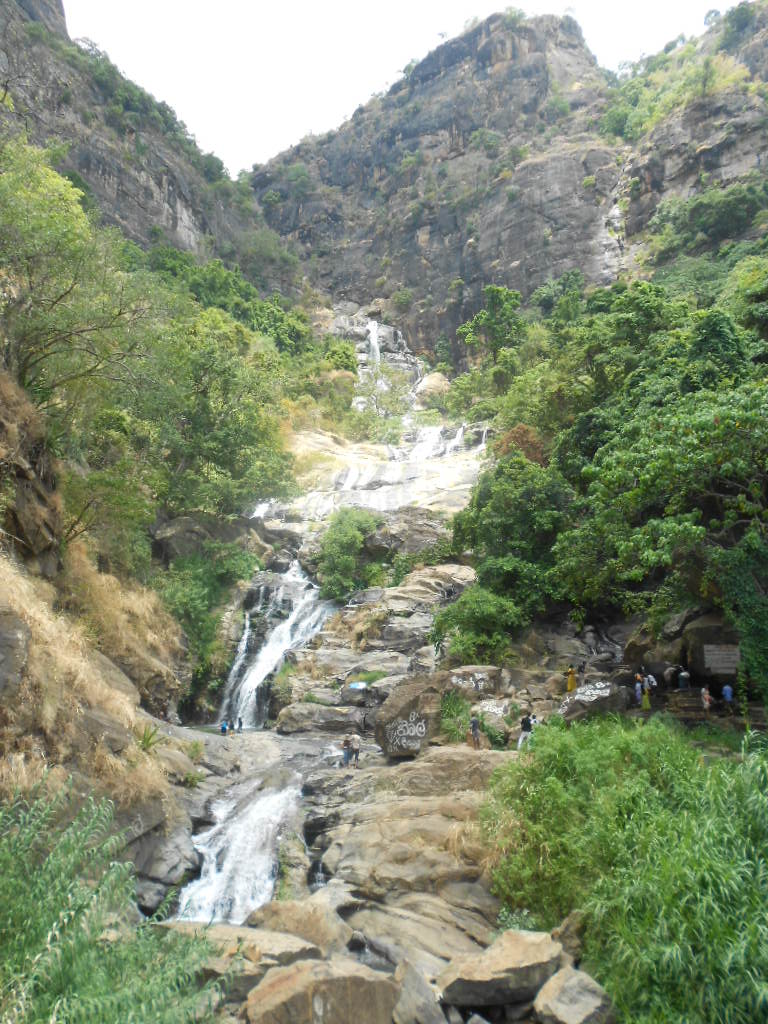
I could not help but laugh when I found an election campaign advertisement drawn on a rock with white paint at Rawana Ella Falls, one of the nation’s most famous (and beautiful) falls. It is of course banned.


2011-07-31

Sunflower@ Zama: July 31, 2011


Sunflower again!


I visited sunflower fields for two consecutive days. Today’s visit was a field in Zama City, Kanagawa Prefecture.


Zama’s field was much larger than the field in Setagaya’s Unane I visited yesterday. There were more than 100 thousands sunflowers there.


A path ran through the flowers. Visitors enjoyed walking in the field.


Zama is about 40 km west from central Tokyo. Sunflower is the city’s flower. It holds sunflower festival since 1993.


Zama is also famous as a hometown of Nissan. Nissan had its main automobile factory here till 1995. The factory was closed as a process of the company’s restructuring plans. The facility is now used as a R&D center.


Japanese automobile companies have days off in weekdays and open their offices and factories in the weekend to cope with the shortage of electricity after the earthquake (and the nuclear plant accident). Zama's center was open today.

Map: Zama