2016-11-20

Jakarta: Indonesia's economy & infrastructure: Nov. 12-19, 2016


During my stay in Jakarta, I saw new developments of the economy.

You may find many motorbike drivers and pillion passengers with green helmets in Jakarta. They are drivers and riders of Go-jek, a new bike service expanding rapidly. (See also the top photo)

The operation company was established in 2010 by a young entrepreneur. It is like UBER’s service in Indonesian style. He developed a new application on the smart phone and successfully established a network which connected the bike drivers and the customers.

Now, more than 200 thousand Go-jek drivers are in operation in Jakarta and other cities. The company expanded its business into automobile service, delivery service and other related services. Conflicts with traditional taxi driver are occurring.

UBER and other firms followed Go-jek in providing bike service. It is an example of digitization as well as liberalization of the economy.

Developing infrastructure is one of the most important economic policies in Indonesia. The first MRT (massive Rapid Transport) system is under construction in Jakarta. The first stage is planned to link central Jakarta and southern Jakarta (about 15.7km) by the end of 2018.

The MRT will run underground in the central city. I have taken many photos at the Bunderan HI, the city center, since last year. I took it again.

I also visited southern part. I saw the consrtuction at Senayan, about four km south from Bunderan HI. (see the 2nd photo from the top)

The MRT will ran over the ground in the southern part. The construction of overhead railway is under way.

Only columns stand in the Bloc M area.

Still the infrastructure shortage is serious. The roads and highways are always jammed. (see the 3rd photo from the top)

I found the industrial parks were well developed when I visited Cikarang, in the east outskirt of Jakarta. The connections which connect the industrial parks and the highways as well as the ports are bad.

The situation in Sumatra and other islands are worse.

There are more than 100 shopping malls in Jakarta, according to a local journalist. In addition to the malls in Tamrin, central Jakarta (I wrote the information in my “the weekend in Thamrin” blog), I visited malls in the Bloc M areas, both are in the south of Jakarta. I saw rich and ordinary people enjoying shopping and foods.

I also visited a mall in Senayan.


2016-11-13

Jakarta: weekend-walk @ Thamrin: Nov.12-13, 2016 (off off Tokyo)


I visited Jakarta for the second time in the past 12 months. The city is energetic and messy as it was a year ago.

The construction works of subway (MRT= Mass Rapid Transportation) was still under way. The traffic jam was heavy.

I walked around the crossing of Bundaran HI monument at Thamrin, central Jakarta. Modern shopping malls such as Plaza Indonesia and Grand Indonesia are in the area. There also top-level hotels.

There are Christian Dior, Gucci and many other brand-name stores in the malls. The places are spacious. People need to have security checks when they enter the mall.

The visitors looked neat and rich for me. There were many foreign people.

People also enjoyed their dinners in the weekend evening.

I found the prices at the restaurants were as expensive as those in Japan. The situation is similar with many other goods sold here.

There are many open-air stalls outside of the modern shopping malls. The contrast was impressive. (See also the 2nd photo from the top).

The water drainage is bad as it was a year ago. The road was covered with water when they had a rain.

I also visited The Thamrin City mall, which locates a bloc from Plaza Indonesia and Grand Indonesia. 


The mall attracted average local people. I did not have any security check when I entered.

There are many small stalls in the floors. They were crowded with people. I saw few foreign visitors. The prices were generally cheap.

There are hundreds of cloth shops in the huge six-floor commercial complex. Some of them sell Islamic fashions. (see the top photo)

They also have grocery shops and mobile phone shops.


2016-11-02

Nakasendo Walk (20) Agematsu (38/69) – Suhara (39/69) – Okuwa: Oct. 31, 2016


I started my walk today from Agematsu. There was a big news for the town today.

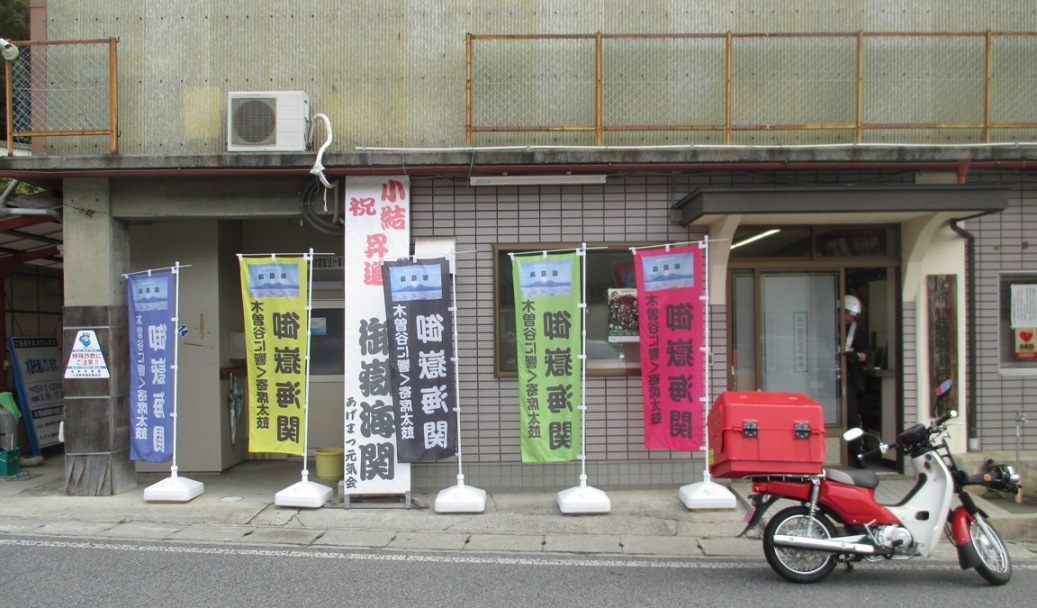
A new ranking of sumo wrestlers was announced today for November tournament to be held in Kyushu. Mitakeumi, a wrestler born in Agematsu Town, was ranked at Komusubi, one of the top ranks called sanyaku. It is the first sanyaku wrestler in 84 years from Nagano Prefecture.

An extra was delivered in the town. NHK sent a camera team to record the joy of the town.

There are flags, posters and hanging displays to cheer Mitakeumi. Sumo plays a big role for the local communities.

Agematsu is famous for its Japanese cypress trees. Polls stand in front of the railway station.

Old houses and inns remain along Nakasendo.

There is an elderly nursery house along the road. Aging is a big issue for Japan, but the situation is more urgent for the rural areas.

I also saw mini-vehicles of the elderly care services running around the areas. They visit the houses of old people, some of who live alone.

I found a beautiful fall called “Ono no Taki”.

I continued walking in the countryside. Japanese persimmon trees hold many fruits.

I suddenly met a group of monkeys. They were eating persimmons when I noticed them.

Kiso River runs fast in some parts and moves slowly in other parts. It flows slowly in the area. I found there were many big stones in the river field.

There is a lumber factory along the river.

I also found a hydro power plant in the border area between Agematsu Town and neighboring Okuwa Village. It is called Momoyama Plant. It is historically important as it was built in 1923 by Momosuke Fukuzawa, a famous businessman from Meiji to early Showa eras.

I walked into Suhara, the 39th station. Suhara is in Okuwa Village.

They use water storage tanks called muzubune there. They are made of cypress tree.

The combination of mizubune and traditional houses was very impressive for me.

I found mizubune not only in the residential arras but also in front of a temple and in the fields along Nakasendo.

Suhara has traditional folk songs as do other communities. There is a music box which plays Suhara Banesa, one of the region's songs. I enjoyed it.


I found another water dam of Kiso River.

The autumn color was beautiful.

I ceased todays walk at JR Okuwa station, which is between Suhara and Nojiri, the 40th station.


Nakasendo Walk (19) Miyanokoshi(36/69)-Agematsu(38/69): Oct. 30, 2016


I stated today’s walk from Miyanokoshi, which is famous for Kiso Yoshinaka (see previous article posted on Oct. 29, 2016). 

The town was calm with a few stores.

I walked about a half hour and arrived at the central point of Nakasendo’s 533 kilometers. I saw the Kiso mountains stand behind the monument. see the 2nd photo from the top).

There are various sculptures and monuments along the road. They include the guardians of the communities, the goddess of Kannon and others. I found a stone plate which had been used for the ceremony to pray for the moon.

I walked about two hours and arrived in Fukushima or Kiso Fukushima, the 37th station.

There was a checking station of Nakasendo here in the Edo era. Travelers were required to be inspected. Some facilities were restored. A big gate was built on the road to symbolize the check station. I found a drawing just under the checking station.

The town lies in the narrow valley of Kiso River. Old houses remain in some parts and the mountains stand quite near.

Kiso Fukushima is the center of local business and social activities. The express trains stop here. The main hospital of the region with heliport is here.

I also found a dam outside of central Kiso Fukushima. (see the photo 3rd from the top)

Both Miyanosaka and Fukushima stations are in Kiso Town.

Some parts of Nakasendo is converted into the National Rout 19 and the railways run along the road. 

Other parts keep the old form of the Edo era. It sometimes goes through the woods.

I walked a few kilometers and entered into Agematsu Town.

There is a beautiful bridge named “Kiso no Kakehashi”. The autumn color behind the bridge was especially beautiful.

I arrived in Agematsu shukuba, the 38th station. Most buildings of the station were burned in the big fire of the Showa period.