2015-05-10

Tokaido Walk (32) Kusatsu-Otsu (off Tokyo): May 5, 2015


My Tokaido Walk is in the final stage. I walked from Kusatsu, the 52nd shukuba station, to Otsu, the 53rd station, today.

Tokaido and Nakasendo, which also connected Edo (Tokyo) and Kyoto through mountain areas, met at Kusatsu. I found a monument at the meeting point of the two ancient roads.

There is a tunnel at the side of the monument. The tunnel goes under the old Kusatsu River.

It was a raised-bed river. People sometimes had flood disasters in the Edo era and they made tunnels under the river after the Meiji period.

The tunnels remain at several places in the city. (see Tokaido Walk 31).

A new artificial river was constructed and the old river is now dried up. I found old people playing gateball in the riverfield when I passed the new river.

An old honjin or main inn remains in the shukuba of Kusatsu. The city plans to renew the  area and to add new information services there to attract tourists. It is also scheduled to take off all electric poles from the district in years.


I walked into Otsu city and arrived at the Seta River. The river flows out of Lake Biwa, changes the name (of the river) to Uji iver and the Yodo River, then pours into Osaka Bay. More then 800 rivers flow into Lake Biwa and only the Seta River goes out.

The bridge over the river is called “Seta-no-Karahashi” and has been famous from the ancient era as its geographical importance.

There were many boat teams practicing. The river was blue. The scene looked beautiful and peaceful. (top photo)

I felt algae-like smell at the same time. The lake had a lot of algae in the summer time and the “pollution” became a big issue decades ago. The situation has been improved, but they still have the algae smell in summer.

The site of the old Zeze Castle is now converted into a park. It locates at the side of Lake Biwa. Families enjoyed their holidays.

The site of the old Otsu Castle is now used as a port. 


The fountain shows are played several times every day. I enjoyed one of them. There are many new apartment houses build around the lake in the area.

I also visited the Mii-dera Temple, the head of Tnedai Jimon sect. The scene of Lake Biwa from the temple was beautiful.


Kyoto (off Tokyo):May 4-6, 2015


I visited Kyoto twice (on May 4th and 6th) during my Tokaid Walk in the Kansai Area.

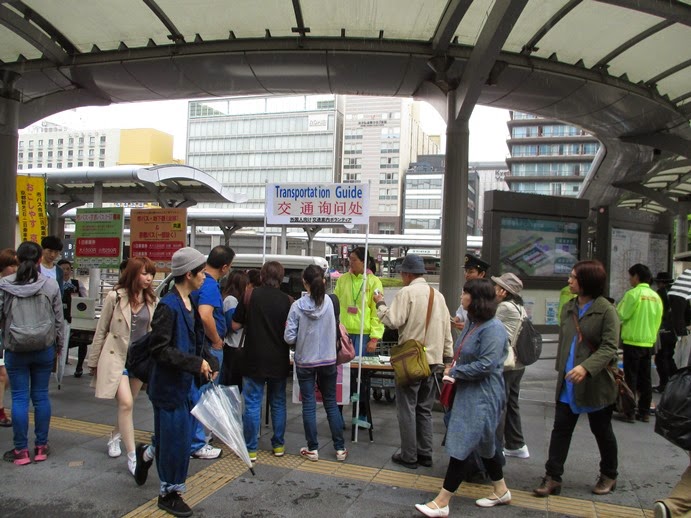
The Kyoto railway station was crowded with tourists. There were many Japanese families (as it was the Golden Week holiday season). There were lots of foreign visitors, too.

I found a guide working hard at a tourist center in the ground floor. He was taking inquiries from foreign tourists from various countries. I talked with him and was informed that he is Chinese and he speaks Chinese, English and Japanese. No Japanese staff members were there.

At the entrance, I found Japanese volunteers helping foreign visitors. The improvement of the services for foreign tourists is remarkable in recent years.

I took a tour bus and visited Kinkakuji Temple (the Golden Templae), Daitokuji temple, Shimogamo Shrine and other places. It was rainy on May 4th, and the Golden Temple in the rain was fantastic. The temple is designated a World Heritage site. (top photo)

The Shimogamo Shrine is also registered as one of the World Heritage sites. The shrine plans to build apartments in its territory (outside the World Heritage area) and is becoming a topic.

I visited Kiyomizu Temple and Chionin on May 6th. (2nd from the top)

I saw many foreign visitors in Japanese traditional Kimono costume.

I enjoyed the days in Kyoto.


2015-05-04

Tokaido Walk (31)Minakuchi-Kusatsu (off Tokyo):May 3, 2015


It is the second day of my Tokaido Walk this time. It was from Minakuchi, the 50th shukuba Station, through Ishibe to Kusatsu. They are in Shiga Prefecture.


The atmosphere of Old Tokaido remain in many parts in the area.


Minakuchi is in Koka City. Koka is known as a name of famous Ninja school (Another famous one is Iga). Minakuchi, Tsuchiyama, Koka and other two towns merged into Koka City in 2004. 
Minakuchi Castle was built in the early Edo era. The town developed around shukuba station and the castle. The castle was destroyed in the Meiji period, but was renovated in the post war era.

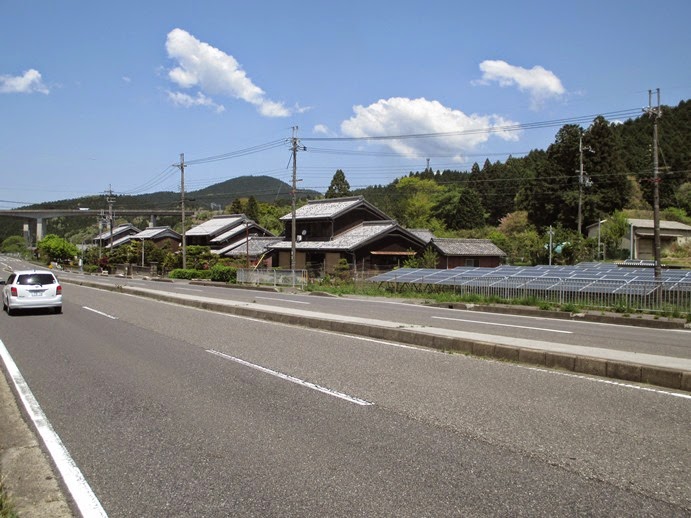
I walked out of the shukuba district and found Tokaido ran straight to the west. Wide rice fields spread along the road. Pine trees were planted at the roadside. Now, the road is paved and power poles stand along the road, but the combination of long straight road and wide rice fields remain from the Edo period. 

There are many signboards of boys and girls and Ninja at the sides of the road to get attention of the drivers(2nd from the top).

I moved into Konan City, crossed the Yasu River, walked another 5 kilometers and arrived at Ishibe, the 51st shukuba station. 


I found a big solar power generation plant along the street (top photo). I also saw other plants along Tokaido in Shiga Prefecture.

It became more urbanized as I moved forward. There are houses, agricultural fields and industrial plants along the road. The Meishin Highway, which links Osaka and Nagoya, runs near Ishibe.


I passed Ritto City before arriving in Kusatsu City. I saw Mt. Mikami or Omi Fuji over the wheat field. 
The Kusatsu River used to flow in the central part of Kusatsu CIty. It was a ceiling river (raised-bed river). It is now dried up as new artificial river was made, but the tunnels remain.

I arrived at Kusatsu shukuba, the 52nd station.


2015-05-02

Tokaido Walk (30) Sakanoshita-Minakuchi (off Tokyo): May 2, 2015


I resumed my Tokaido walk after a year's interval. Today’s walk was from Sakanoshita in Mie Prefecture through the Suzuka Pass to Minakuchi in Shiga Prefecture.

Sakanoshita is the 48th shukuba station from Nihonbashi, Tokyo. It locates quite near from the Suzuka Pass. It was a big shukuba station with about 160 inns in the Edo era, but it is now a small village with tens of houses and no hotels.

I found tea fields there.
There were high ways through the mountains. I also found steel towers to bring electricity on the mountains over the village.


I walked up the mountain road.


I saw cans, plastic sacs and other garbage wasted under the highway. It was shameful.

With about 30 minutes walk, I arrived at the Suzuka Pass. It is 357 meter high and is the border between Mie and Shiga Prefectures. A beautiful tea field spread in the area (top picture).

I walked down the slope. There are farmers' houses along the road. I found the fences around the rice and other farm crop fields. The purpose is to prevent monkeys and other animals from coming into the place, according to a farmer.

I found a solar panel generation system introduced at the side of the road. 

The New Hanshin Highway was built in this ten years.

I walked nearly 10 kilometers before arriving at Tsuchiyama, the 49th shukuba station. 
Tsuchiyama preserves the old atmosphere of the town. Many housed are reconstructed in traditional style. The sukuba station town continues about 2.5 kilometers.

The tea fields are in the shukuba station. 


I found the old name of the house (e.g. Hotel Torii) displayed in the board. This type of board sign were found in many places along Tokaido in Shiga Prefecture.


I had another 10 kilometer walk and arrived at Minakuchi, the 50th station.


2015-05-01

Sakura-ebi shrimp drying @ Fuji River (off Tokyo): April 25, 2015


Sakura-ebi, a small shrimp of three to five centimeter, is a seasonal delicacy in Japan. It lives only in Suruga Bay in Shizuoka Prefecture and fishermen are allowed to take it a few weeks in spring and autumn respectively. The Yui port in Yui region in Shizuoka City boasts the biggest catch landing.

Some of the landed shrimps are eaten fresh. Others are frozen or dried to sell.

I visited the river field of Fuji River, where the shrimp were dried in the sun. It is, of course, possible to dry the shrimp in the machines. However, it tastes better when it is dried naturally.

The shrimp turns pink as it loses the water inside. It looks like a pink carpet when I saw it from a distance.

You can see Mt. Fuji over the shrimp when you are lucky. Today, I was not.

At Yui port, tens of fishing boats were tied up. There was an open-air restaurant of Sakura-ebi, and tens of people were making a line.


I had Sakura-ebi lunch. It tasted good.

2015-04-18

Godzilla @ Shinjuku; April 18, 2015


It was about a week ago when Godzilla appeared in Shinjuku. I went there to see it today.

The Godzilla head is placed at about 50 meter high on a building of Toho, a cinema company that produces Godzilla movies. As Godzilla’s height is estimated about 50 meters, it is “real”.
It was at the center of Shinjuku Kabukicho. Toho’s old “Koma” theater was closed in 2008 and a new cinema-shopping complex was built. The operation started on April 16.

Huge Hotel Gracery with more than 1000 rooms was also built and will open in a few days. The Godzilla head will be seen close from some rooms.

There are many visitors, including foreign tourists, in the area. Many of them enjoyed taking pictures of Godzilla.


Kabukicho is one of the busiest and most controversial amusement spots in Tokyo. 

Shops with variety of economical goods and interesting souvenir attracts foreign visitors. 


It is also true that sex shop and other morally questionable industries prevail. Crimes and troubles are often reported.

The situation is better than years ago, when the conflicts of mobsters were often reported. Japan, not China, was the economic giant Asia at the time and Kabukicho was said to be the biggest entertainment area in Asia.


Policemen were walking around the area and the announcements, which call for the attention of visitors not to listen to the soft words of pullers-in, were made.


Spring flowers and fresh green @ Baji Park; April 12, 2015


The season of most popular cherry (somei yoshino with light pink flowers) is already over. Now, we have other spring flowers.

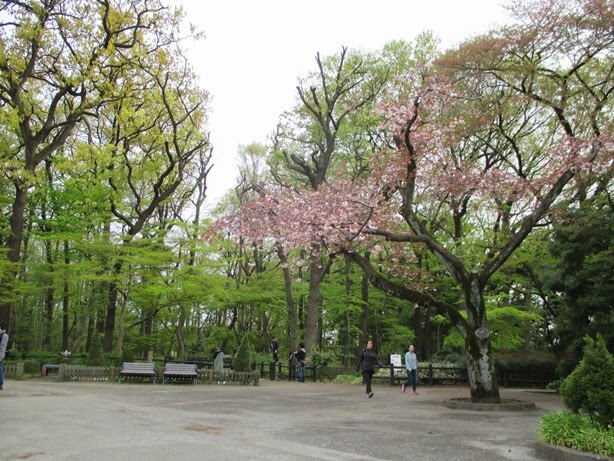
I visited Baji Park in Setagaya today to enjoy the spring afternoon. The blossom of yaezakira, a cherry with stronger pink flowers, was its peak. Many families were reluxing.

I saw a group of Asian people enjoying a picnic under cherry trees. The event is more and more internationalized.

Tulip, pansy and other spring flowers were also open.

Fresh green was growing on the trees. The day is becoming brighter.


2015-04-05

Cherry Carpet @ Gotokuji Temple: April 5, 2015


The cherry blossom days are finishing. The flower started to fall silently.

I visited Gotokuji Temple in Setagaya Ward and found the ground covered with pink cherry flowers.

Flesh-green leaves appeared in many trees.

The season is turning from early spring to mid-spring.