2014-11-08

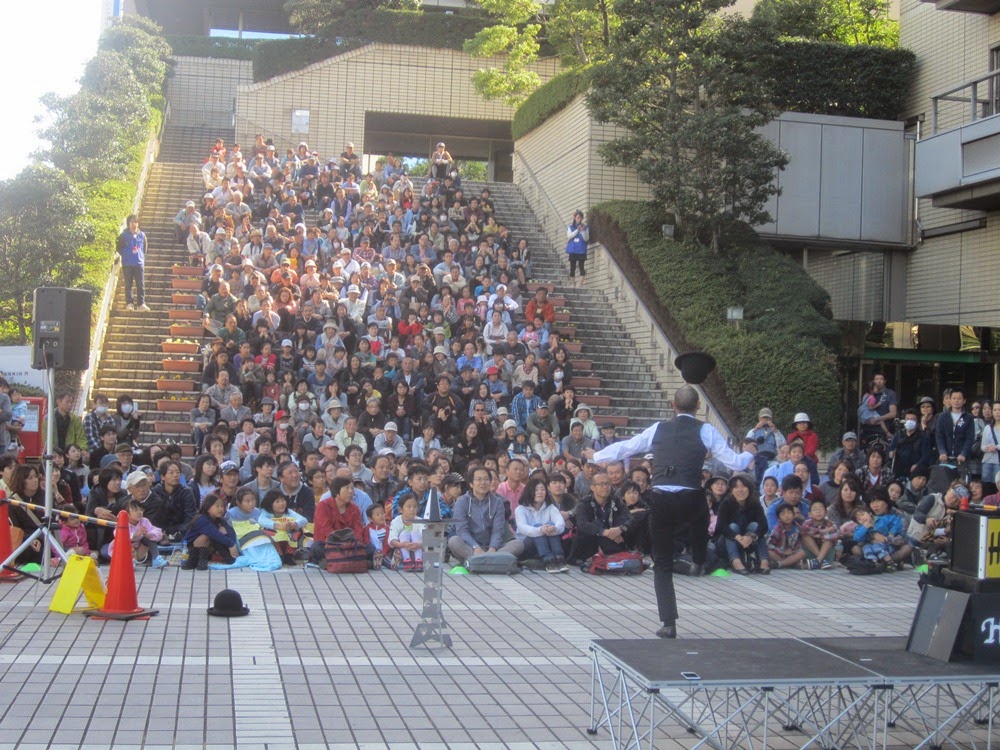
Street Performances (Daidogei) World Cup@ Shizuoka (off Tokyo): Nov. 3, 2014


Today is a national holiday (Cultural Day). I visited Shizuoka City, the capital of Shizuoka Prefecture, about 160 km west from Tokyo to see the World Cup of street performances (Daidogei).

I was welcomed by clowns when I got off JR Shizuoka station and moved into one of main streets of the city. The clowns are played by the volunteers to support the event. Steward, traffic control persons and many other event staff members are also volunteer members.

The performances were played in the park, main streets and other public spaces. An artist attracted hundreds of audiences with his "hat" plays in the place in front of the city hall (2nd picture from the top).

Artists played various performances including the juggling acts in the Sumpu Castle Park. 


Kid were practicing juggling in places not far from the artists’ stages.

The event started in 1992. It attracts nearly 2 million visitors every year.
This year's Cup was held from October 31st to November 3rd.  More than 90 artists (individuals and groups) participated in. The championship was given to a pair of an American and a Spanish, who played performances using bicycles.

The event is useful not only for tourism in the region bat also for the internationalization of the area. Children have more opportunities to know foreign people through the event. They also meet many volunteers and understand the importance of such activities.

It was interesting.


Yoyogi Park : Nov. 2, 2014


The Yoyogi Park, one of the most popular parks in Tokyo, was temporary closed in August because of dengue fever. Mosquitoes infected by dengue virus were found in the park. The Tokyo Metropolitan government banned people enter the place.

The gates opened again in Late October (about three months after the closure). As a lover of the the park, I immediately visited there.

The leaves turned yellow (top picture). Many people were there. They enjoyed jogging, walking, and spending their times on the lawn or benches (2nd from the top).

New dog-run fields were open. Large and small dogs were running happily. The owners enjoyed talks.

I moved to neighboring Meiji Shrine. An autumn festival was held. The traditional music was played with Shakuhachi (Japanese flute), Koro (Japanese harp) and other traditional instruments.

They also held an exhibition of chrysanthemum.

Autumn deepened.


2014-10-30

Meguro, Rinshinomori Park: Oct. 26, 2014


Meguro is one of the railway terminal stations in western Tokyo. Residential areas spread behind commercial district. I visited there today.

There was a hippodrome the early 20th century there. The memory of the institution remains. Old tracks are now used as streets.

A forestry research center was built in the area about 115 years ago. It has turned into “Rinshinomori Park”. The park was woody. I found many tall trees and various kind of grasses.

It was the late 20th century when people started to celebrate (widely) Halloween in Japan. It was Halloween weekend. I found many kid in Halloween costumes.

I also visited the Parasitological Museum. The museum says it is the only such facility in the world. Various kinds of parasites were displayed and the 8.8 meter long tapeworm was especially impressive.


Mt. Takao: Oct. 25, 2014


Autumn deepens. The leaves started to turn the colors.

It was a fine day today and I visited Mr. Takao, in western Tokyo. It is the most popular mountain in Tokyo Metropolitan area.

The sky was blue and the air was fresh. There were many visitors as often the case at this season.

The autumn color has just begun. Some maple trees had red leaves while many other trees remained green.

There are many mountains around Mt. Takao. The scene from the top was beautiful (top picture).

There were many foreign visitors and I heard Chinese, Korean, Russian, English and other languages. The mountain is becoming more and more international.


2014-10-12

Community event @Hanegi Park: Oct. 12, 2014


Traditional autumn festivals at shrines are seasonal fun for Japanese. We have more. There are various community festivals and events, too.

I visited an event titled “zakkyo festival” (various events in-one-place festival) held in the Hanegi Park, in Setagaya ward.

Music, dance and many other performances were played. Various NGOs and NPOs, including organizations aiming supports for the disabled, held their exhibitions.


Pottery creators from quake-hit Fukushima Prefecture opened stalls. Importers of Asian and African good also opened stalls.

Some events attracted young people while some were not popular. I saw various aspects of social and cultural activities there.


2014-09-28

Nagano’s mountains (off Tokyo): Sept. 27, 2014


I visited Sakaki and Miyota in the eastern part of Nagano Prefecture. Both are small towns.

Nagano is mountainous. Cities and towns locate in the basins and valleys. We see mountains almost everywhere in the prefecture.

They grow various vegetables and fruits as well as rice there.

It was the harvest season.

Farmers were in the process of harvesting rice. Parts of the fields were covered with golden rice grass while other pars were already cut.


They were drying the the products.
I also saw apple trees in many places. The picture was taken in the garden of a Japanese noodle restaurant.

They have many hot springs in Nagano Prefecture. Sakaki town has a public bath and I visited there.

There were open-air bathes (several bath tubs) and I could see beautiful landscape of mountains from the place. It might be a paradise.

Miyota town locates at the foot of Mt. Asama. The mountain is an active volcano and it is banned to climb up to the top. (the top picture)

Mt. Ontake, which locates in the western part of Nagano (about 120 km from Miyota) erupted on Sept. 27, the very day I visited Nagano, and more than 30 climbers were killed in the accident. I watched the news in the TV and I was so sorry.

Autumn Festival @ Yoyogi Hachman Shrine: Sept.23, 2014


Here came the season of autumn festivals. I went to Yoyogi Hachiman Shrine.

Autumn festival begun as a ritual ceremony to thank god the harvest. It has become an important event of the year for the communities.

Members of each community (town) in the area carried a portal shrine (mikoshi) and moved around the region. They were in traditional costumes.

The shrine was crowded with visitors. The watched the mikoshi parade, enjoyed foods, and prayed. Kid were enjoying games.


There were tens of open-air stalls in the shrine.


Now, the dengue fever and mosquitoes are the often-spoken topic in Tokyo as mosquitoes with dengue fever virus were found in several parks. One of the parks was Yoyogi Park, quite near from the shrine. 

The festival was as popular as usual.


2014-09-13

Belgium Beer Weekend @ Roppongi Hills Sept. 13, 2014


Belgium beer has special meaning for me as I once lived in the country. I visited Roppongi Hills to join the “Belgium Beer Weekend” event. It was the second time, following the event held in Yokohama in July, to participate in the event.

There were thousands of people in the event site when I arrived there. 

Tens of Belgium beer as well as fritz and other Belgium foods were served. Music events were performed.

The weekend event started in Roppongi Hills about five years ago. It has successfully developed. The event has been held in 6 cities – Nagoya, Fukuoka, Osaka, Yokohama, Sendai and Tokyo, in 2014. It has become famous and the participants have increased.

Beer and other goods were sold at Belgium gift corner. The special recommendation packs of beer were arranged by “Belgium beer knights”. I bought a pack.


Sumo & autumn festival @ Setagaya Hachiman Shrine: Sept. 13, 2014


Autumn festival season has started. We hear the sound of Japanese flute and dram in many towns in the weekend at this season, as some of shrines or temples in the regions have festivals. The autumn festival originally began to thank god the harvest of the year.

I visited Setagaya Hachiman Shrine. The festival here is unique as it has special sumo plays.

The sumo wrestlers are from Tokyo University of Agriculture. They are top-level student sumo wrestlers and some of them may become professional wrestlers. Some members were from Mongolia.

Sumo ring was properly arranged. There were hundreds of audiences surrounding the ring.

There were various kinds of matches – singles match, group tournament, kinds of knockout competitions etc. Heavy sounds spread when wrestlers’ big bodies crash.

It was so interesting and I dove into watching the plays for about two hours.

Not everyone was in sumo site. There were many visitors walking in the shrine.

Open-air stalls were open. Kids were enjoying  tasting sweets and playing the gold fish-catching games.


2014-09-06

Red spider lily @ Setagaya Castle ruin: Sept. 6, 2014


We had unusual weather this summer in Japan. Concentrated heavy rain attacked several areas and gave serious damages. More than 70 people were killed in the disaster in late August in Hiroshima city.

Dengue (breakbone) fever news is running around Tokyo right now. Tens of infected patients have been found since last week, and disease-bearing mosquitos have been found in some parks in central Tokyo.

Now, I am a bit hesitant to walk in the park. Instead, I walked along the street in Setagaya ward.

Red Spider lilies were already open in the Setagaya-joshi Park, which is built on the ruin of Setagaya Castle of medieval period. It is only a week later after I enjoyed watching sunflowers in Roka Park in the same area on August 31.

The season is turning from hot and unusual-weather summer to autumn. I hope that we have normal fall season.