2013-08-20
Tokyo's Hot summer: August 15, 2013
Tokyo had historically hot summer this year.
Temperature sometimes reached 37 degrees. Heavy rain with thunders suddenly started in some areas, which caused blackout and suspensions of train operations.
It was hard to walk long in daytime this month. I only had short walks in the weekends. Many women carry parasols. Business persons were sweat. Everyone looked being fed up with the heat.
2013-07-28
Summer day’s walk in Tamagawa River area: July 27-28, 2013
I had walks around western part of Setagaya ward and Tamagawa river area (Tokyo-Kanagawa border) this weekend.
Sounds of cicadas buzz were heard in the walkways, parks, and many places in the area. Empty shells of cicadas were found in the grasses and trees.
Sunflower and many other summer flowers were open in Soshigaya Park at the side of Sengawa River.
Birds, butterflies and grasshoppers moved around in the river fields of Tamagawa River.
Sweat flew out of my body.
2013-07-18
Ocean’s Day @ Odaiba & Rainbow Bridge; July 15, 2013
Today is Ocean's Day (national Holiday). I visited Tokyo Bay Area to see the sea. Today’s activities included a walk across the Rainbow Bridge, which linked Odaiba and Shibaura over the Tokyo Bay.
Odaiba is an artificial island developed gradually after the Edo era. Cannons and other defense facilities were installed in the late Edo era. Artificial islands made by the Tokugawa government still remain.
Modern commercial, business and cultural facilities as well as residential apartments have been built after the 1990s. Today, it is one of most fashionable areas in Tokyo.
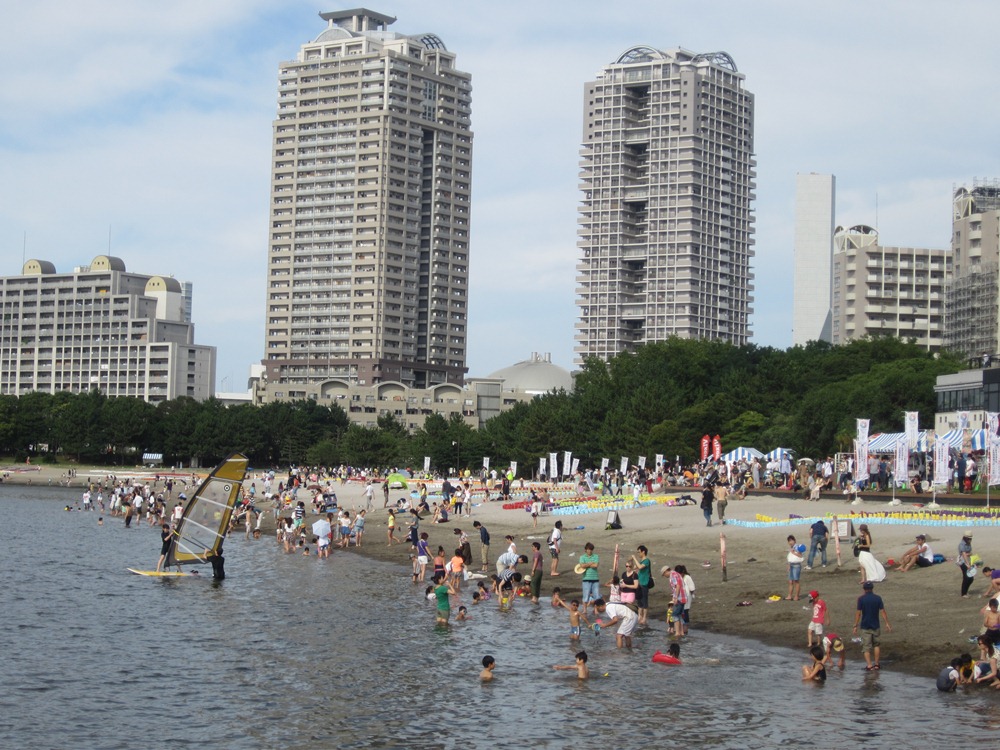
It was extremely hot today. Thousands of people were in the artificial beach. Children enjoyed sea bathing and young people moved sailboats. I saw the Rainbow Bridge and central Tokyo’s skyscrapers were behind the beach.
I found many young people enjoying costume plays in the park in the area.
I crossed the Rainbow Bridge. The wind was strong. The Tokyo Bay was just under the bridge. Ships and boats were sailing. It took about 30 minutes.
2013-07-07
Star Festival@ Hiratsuka: July 6, 2013
Rainy season is over (The Meteorological Bureau declared the end of rainy season today). It was about two week earlier than usual. It was hot and fine today.
I visited Star Festival held in Hiratsuka City in Kanagawa Prefecture. Hiratsuka’s Festival is one of three major festivals in Japan (other two are held in Sendai and Ichinomiya, Aichi Prefecture).
Hundreds of decorations were places in two major streets. Various hopes -- recovery from the Great East Japan earthquake disaster, victory in the football World Cup games, happiness of people, etc. -- were displayed in the decorations. Thousands of people were walking under the decorations.
Many people were in traditional yukata costume.
There were hundreds of open-air stalls in other street. Visitors enjoyed eating and drinking.
Hiratsuka’s festival started in 1950 as a symbol of reconstruction from World War 2. More than 3 million people visit the festival every year.
2013-06-16
Iris @ Meiji Shrine: June 8, 2013
Here again came the season of Japanese iris. I visited Meiji iris field in Meiji Shrine.
The field is in the wood. Thousands of purple and white flowers were open. Butterflies were floating and birds were singing.
Many visitors were taking pictures.
Rainy season will start shortly.
Sanno Festival @ Hie Shrine: June 8, 2013
Edo’s three major festivals include Kanda Festival @ Kanda Shrine, Sanja Festival @ Askusa Shrine, and Sanno Festival @ Hie Shrine. I have already visited first two festivals. I visited the third one today.
Hie Shrine locates central Tokyo. It is only few hundred meters from Prime Minister’s house and Japanese Diet. The shrine is now surrounded by buildings.
The shrine has big festival and small festival every each year. This year’s festival is small one. There is no large-scale mikoshi (portal shrine) parade planned this year. Rather, a series of small events is scheduled.
A ceremony for small children was held when I visited there. Boys and girls were in traditional costumes. Parents and grandparents were taking pictures.
It was a hot summer day.
2013-05-26
Koshu Kaido Walk (5) Hino-Hachioji: May 26, 2013
I had my first Koshu Kaido walk this year. It was from Hino to Hachioji.
I started today’s walk from Hino, a city about 40 km west from central Tokyo. Hino Motor’s headquarters (and main factory) locates at the side of Koshu Kaido. Other factories including Konika Minolta’s are also in the area.
Most of old Koshu Kaido has converted into Nationa Route 20. Gingko trees are planted at the sides of the road.
I moved westward to Takao area. Mt. Takao and other mountains came in sight. Koshu Kaido goes into mountain area west of Takao. It is about 50 km from Nihonbashi.
2013-05-24
Sanja Festival@ Asakusa: May 19, 2013
Kanda Festival tells the start of early summer in Tokyo as described in my last post (May 12, 2013). Sanja Festival in Asakusa is often said to be a symbol of Tokyo’s early summer. I visited Asakusa today.
Some mikoshi were carried by children.
2013-05-12
Kanda Festival: May 12, 2013
It is often said that Tokyo’s summer starts with Kanda Festival. Today was the last day of the Festival and I visited there. It was a clear and hot day.
The festival originally started as an event of Kanda Shrine. It became popular in the Edo era. It is now held every two years. As 2011’s festival was suspended because of the Great East Japan Earthquake, this year’s festival was first in four years.
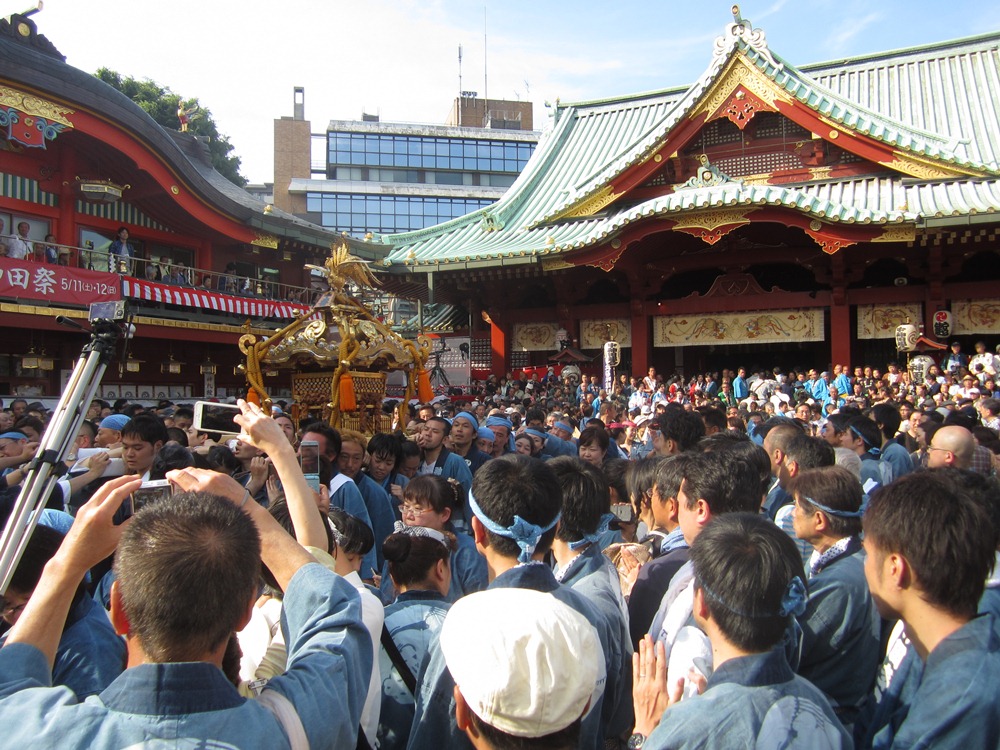
Tens of mikoshi (portal shrine), carried by members of communities in the are, moved around the shrine. People were in happi or traditional costume.
Thousands of visitors watched the performances in the shrine and on the street in the area.
Kanda Festival is counted as one of Tokyo’s three major shrine festivals (other two are Asakusa’s Sanja Festival and San-no Festival of Hie Shrine). It is also counted as one of Japan’s three manjor festivals (other two are Kyoto’s Gion Festival and Osaka’s Tenjin Festival).
2013-05-05
Tokaido walk(26) Okehazama-Miya (off Tokyo): May 5, 2013
It is not too much to say that early modern Japan started from Owari (current western Aichi Prefecture) and Mikawa (eastern Aichi). Three heroes of the country's history -- Oda Nobunaga, Toyotomi Hedeyoshi and Tokugawa Ieyasu -- who reunited Japan and ended the middle age in the late 16th and early 17th centuries were born in the area. Many historically important events took place here.
I started today’s walk from Okehazama. A historical battle took place in 1560. With its surprising victory over Imagawa Yoshimoto, Oda Nobunaga started the process of unification of Japan (and partially realized before his death).
We find many monuments and historical places in the area. The sculptures of Oda Nobunaga and Imagawa Yoshimoto were placed in a battlefield park. The inscription told “the birthplace of early-modern Japan”. In other park, Imagawa Yoshimoto’s tomb was built. I saw several volunteers giving guide services to visitors.
I moved into Nagoya City. My first stop was Arimatsu, an interim station between Chiryu and Narumi. The place is famous for its dyeing textiles named “Arimatsu shibori”. Traditional houses from the Edo era are reserved.
I passed Narumi, the 40th shukuba station from Nihonbashi, and arrived at Miya, the 41st station. People rode on boats here to move to Kuwana, the 42nd station in the Edo era. A lighthouse and other facilities remained in the port.
Famous Atsuta Shrine is near Miya shukuba station. The shrine enshrines Kusanagi sword, a symbol of Emperor’s power in old Japanese legend. It has 1900 year history according to the legend.
Miya shukuba station is about 360 kilometers from Nihonbashi, Tokyo.
Subscribe to:
Posts (Atom)