2018-10-20

Dublin: Oct. 12-14, 2018


I visited Dublin for the first time in about 25 years. The city has dramatically changed.

Historical places attract tourists as they did more than two decades ago.

The Trinity Collage is one of the must-see places in Dublin’s old town. Johnathan Swift, Oscar Wild and many other famous figures graduated this university. Its library and The Book of Kells are especially famous. I found many tourists making a queue in the rain.

The Temple Bar Street, near the River Liffey, has been the busiest amusement and drinking area for centuries. The area has been renovated in the last two or three decades.

Ireland has experienced remarkable economic developments since the 1990s. Many leading financial institutes as well as IT giants opened their offices, including their European headquarters, in Ireland. Many of such offices locate in the newly-developed harbor areas.

Google opened its new offices in 2016. About 7000 people are reported to be working in the offices.

Facebook’s HQ is a huge building. (See the top photo)

Citi group’s office stands along the River Liffey. Jeanie Johnston Tall Ship, which transported 2500 Irish people from here to the U.S. in the mid-19th century is placed in front of Citi’s office.

More than 1 million people died of starvation between 1845 and 1852 when Ireland had the potato famine. Statues of famine people are placed along the river. (See also the 2nd photo)

Messages are displayed in the curtains behind the monument. They include: “Poverty is not natural, it is man-made” and “Leave no one behind.” (See the 3rd photo)

The Emigration museum, not the immigration museum, was open in 2016 near the monument. In the time when anti-immigration is popular in the U.S. and many other European countries, Ireland’s moves to focus on emigration and sympathy for poor people are impressive.


2018-10-11

Autumn Festivals and Events@ Gotokuji, Hanegi Park: Oct. 7, 2018


The season is turning to autumn in Tokyo. The leaves began to fall. Days are getting shorter.

There are many autumn festivals and events – big ones and small ones – held in various areas in Tokyo this season.

I visited Gotokuji, a town around an Odakyu Line station, where I met across a small festival. 

It featured the foods and culture of Okinawa.

Why Okinawa? It is because a student dormitory of Okinawa is in the area.

Student girls welcome visitors at an open-air stall.

Local people as well as their dogs enjoyed the festival.

In Hanegi Park near Odakyu’s Umegaoka station, a flea market and other related events were held.


2018-09-18

Autumn Festivals and Lives in Miyako, Yamada in Iwate: Sept 16-17, 2018


I made my regular visit to Iwate Prefecture. This time, I stayed in Miyako City and Yamada Town to see their autumn festivals as well as current situations.

I joined Miyako's festival in the evening of  Sept. 16.

Teams from local communities and groups of traditional paraded in the city.

A group of Minamikawame district (local community) performed Sansa-Odori dance. The members included many young people.


A carrier with a sail canvas moved around. 

A dram performance was played by a group of Yamaguchi-daiko (dram). Strong sounds spread around the streets. (See the 4th photo from the top)

another team performed a dance with big flags.

Local people as well as visitors enjoyed the festival.

I joined Yamada Town's festival the following day (Sept 17).

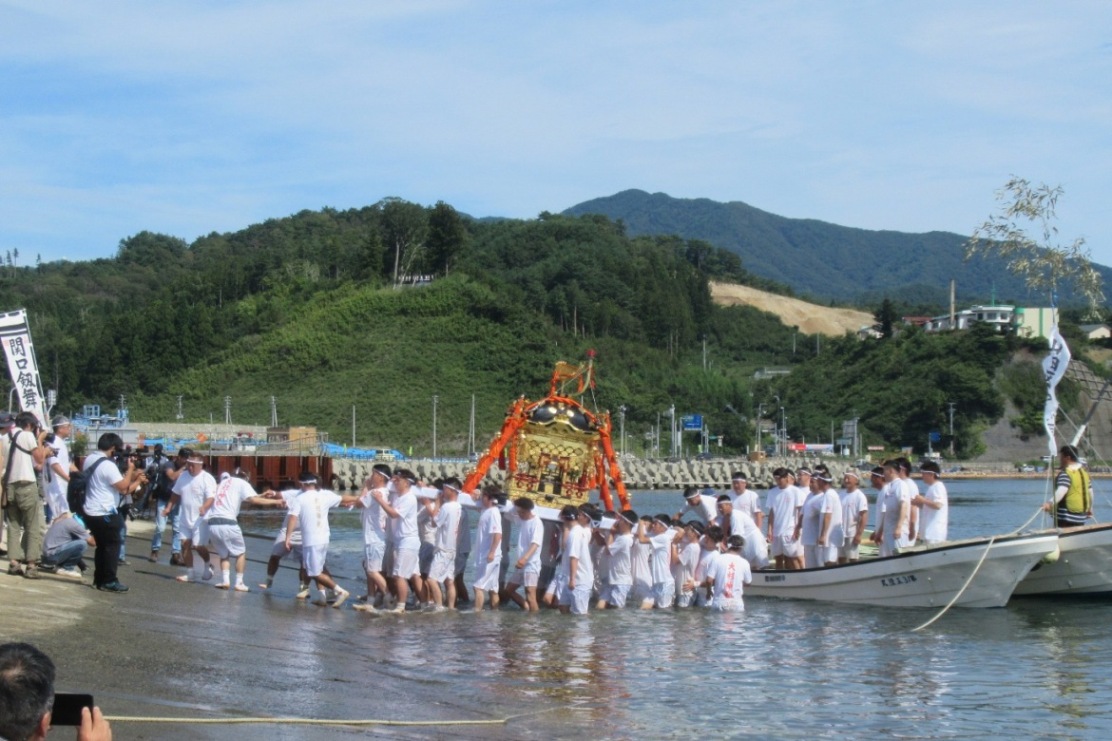
The portable shrines or mikoshi are carried from a shrine to another shrine in the festival. Boats are used to move them. Fish boats join the ceremony and compose a sea parade in the port. 

The mikoshi was just landed when I arrived at the port. (See also the top photo)


Various groups performed traditional arts in the town.

In addition to their regular plays, they hold special performances for specific people who make donations for them.

We asked a team of Daikagura to play a lion dance for us. (See also the 3rd photo) 

We also asked a team of Tiger Dance a performance. (See also the 2nd photo)

It was impressive that many young people joined the festivals, both as players and visitors, in Miyako and Yamada. I also felt strong ties of the people in the local communities.

It is often said that the festivals and traditional performing arts played important roles in the process of recovery from the Great East Japan Earthquake and tsunami disasters in March 2011. I reaffirmed the idea.

In addition to the festivals, I visited Taro district in Miyako City. It was my first visit in four years. Taro is famous for its huge seawalls, which were destroyed by the tsunami disasters in 2011.

Reconstructions have been advanced. New residential areas have been developed on the hills. 

New roads, shops, a baseball stadium and other facilities have been developed in the central parts of the district.


New seawalls are being constructed.

Still there remains a question on the future developments of the district. It is similar in most quake-hit areas in Tohoku.

I experienced a cruising in the Yamada Bay. There are many cultivation rafts of oysters and scallops in the bay

A raft is about 12x4 meter large. It takes two to three years to grow oysters. (See also the 5th photo)

The rafts were all washed away in 2011, when they had tsunami disasters. Now, they have about 2,000 rafts.


Hiraizumi, Iwate: Sept. 15, 2018


I  visited Hiraizumi in Iwate Prefecture, an old town with history of Tohoku district.

Tohoku was an outlying region of Japan for long time. The power of the central government sometimes reached there and sometimes retreated before the middle age.

In the late 11th century, Oushu Fujiwara family established a regime around Hiraizumi. A unique culture flourished here for about 100 years.

There were many episodes in the Fujiwara period. Minamoto Yoshitsune, one of Japan's most popular heroes, tragically died here. Sympathy for him has been shared by Japanese people for centuries. The Fujiwara family perished in  the late 12 century as the rule of the Kamakura shogunate government reached here.

Chuson-ji Temple was developed by Fujiwara Kiyohira, the first ruler of the dynasty’s 100-year triumph.

The temple is famous for its Konjikido, or golden hall (small building). It was made in 1124 by Fujiwara Kiyohira. The hall is 5.5 x 5.5 meters large and worships Buddha Tathagata and other forms of Buddha. The hall is covered with gold.

A larger building, in photo, was built later to cover the hall and to protect it from rains and winds. (See also the top photo). It was prohibited to take a picture of the golden hall. Visit the temple's HP to see Konjikido's photo.
http://www.chusonji.or.jp/guide/precincts/konjikido.html

There are many other temple buildings, including the main hall, in Chusnji.

I walked up a slope to approach the Golden hall and other buildings. (See also the 3rd photo from the top)

Fujiwara Kiyohira developed the temple to console the spirits of the people who were killed in the battles.

Motsuji Temple was redeveloped by Fujiwara Motohira, Kiyohira’s son, and Fujiwara Hidehira, Motohira’s son. Its garden is famous.

Minamoto Yoshitsune was under Fujiwara family’s protection. He was later attacked by the family, as it received strong pressure from the Kamakura government, and was forced to kill himself. His monument is on a hill.

We can see a good view of the region from there. (See the 2nd photo from the top)

Matsuo Basho, a famous haiku poet, visited here 500 years later and made a famous haiku.

The summer grass,
'Tis all thats left,
Of Ancient warriors' dream.

It was translated by Nitobe Inazo, a famous educator in the Meiji period.

Basho's monuments are in many places in the town. A statue in Chusonji-temple is one of them.

The site of administration offices of Fujiwara Family is now a park.


Chusonji, Motsuji and other places were registered as the World Heritages in 2011. Many tourists, including foreigners, visit here.

The audio guide was excellent. People can listen to the explanations of the places in 7 languages as they touch the numbers (or pictures) in the user guide with a pen. I found that the rental cycle system and other facilities were also well developed.


2018-08-31

Washington DC: August 25-26, 2018 (off off Tokyo)


I visited Washington DC for the first time in decades. I walked in and around the National Mall, where the White House, the Congress, many memorials and the Smithsonian institutes gather.

The Lincoln Memorial stands in the west of the Mall. His words are curved in the wall.

I looked eastward from the memorial. The Washington Monument stands over the Reflecting Pool.

Martin Luther King had the famous “I have a dream” speech here in 1963 in the Great March on Washington. Forrest Gump and Jenny had a reunion here. (See also the top photo)

The Congress locates in the east of the Mall.

The White House is in the north of the Mall. Senator John McCain died on August 25, 2018. The flag was at half-mast in the White House in the following day. 

People enjoyed their times on the lawn in front of the White House.

I visited several monuments: They include:

The National World War 2 Memorial,

Martin Luther King Memorial (see the 2nd photo)

Vietnam Veterans Memorial,


Korean War Veterans Memorial

The monument look to be reflecting the views of Americans on the wars and other social developments. There is no monument yet on the Iraq War and Afghanistan War.

I visited Virginia through the Arlington National Cemetery. 

The Iwo Jima Memorial is in this area.