2017-09-21

Shizuoka: Sept. 16-17, 2017 (off Tokyo)


I was in Shizuoka City, about 150 km west from Tokyo, to join a gathering and visited several places during my stay there.

Fugetsu is a garden which locates quite near from the JR Shizuoka station. (See also the top photo)

The last shogun used to live here about 150 years ago. Tokugawa Yoshinobu was the 15th shogun of the Edo government. He returned the power to the royal family (Meiji Emperor) in 1867, which ended the rule of the Tokugawa shogun government which had lasted 260 years.

Yoshinobu moved to Shizuoka after the Meiji Revolution and lived in Fugetsu about 20 years before he moved to another place in the city. Fugetsu is now uses as a restaurant.

I also visited an aquarium in Miho, Shimizu ward of the city. It is operated by Tokai University.

Fish and other marine creatures of the Suruga Bay, which lies in front of the city, are displayed. (See also the 3rd photo from the top)

Anemone fish attracted kids. (2nd photo from the top)

In addition to living lives, specimens are also displayed.

The experiments of tsunami were also carried out. A move in the sea floor makes a wave; it grows as it approaches the sea coast; then, the wave washes away the towns.

They also have a natural history museum in the area.

The typhoon was approaching the area, so they suspended the operation of the water buses.


2017-08-31

Munich and Bayern (Bavaria): August 28-30, 2017 (Off off Tokyo)


I visited Munich and other places in Bayern (Bavaria).

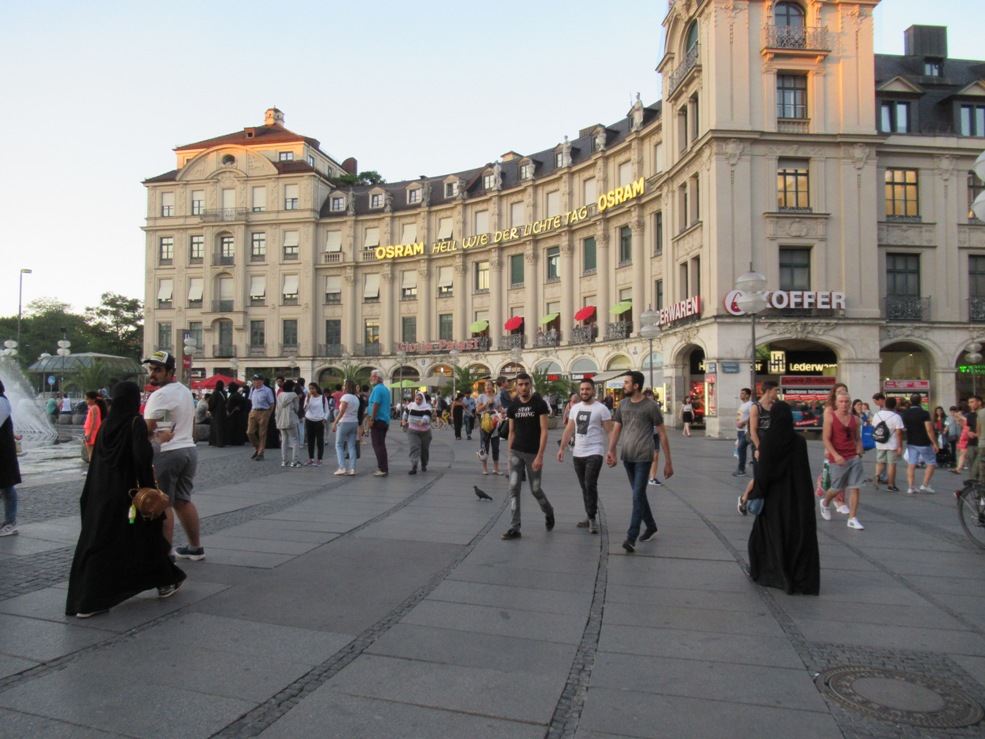
The Marienplatz (square) locates in the center of the city. It is surround by the City Hall, middle age-style buildings and modern shops.

The square is always crowded. Local people as well as foreign tourists gather there.

Political activities are often organized in the square. A meeting organized by Pegida, an anti-Islam group, was held when I visited there.

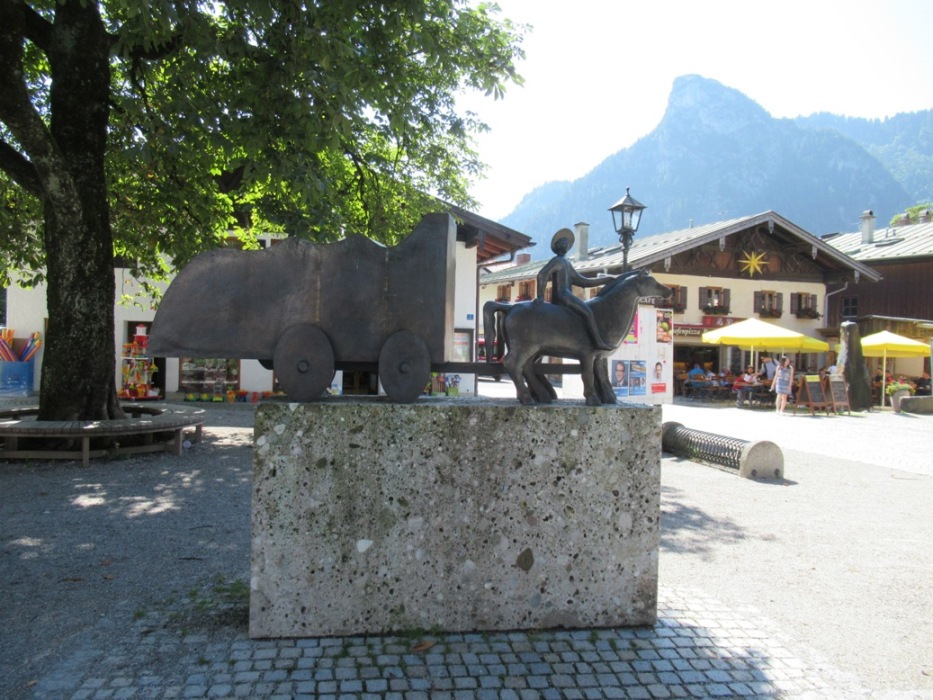
Germany will have a general election on September 24. I saw election posters everywhere throughout the nation, The posters were on the walls, boards, and poles. The photo was taken at Bayer’s village Oberammergau.

About 13%, or one in eight, of total population are foreign-born in Germany in 2012, according to OECD data. There are also many second generation of Turkish "guest workers" after the 1960s. 

I saw many immigrants from the Middle East in Neuhouser Street, which goes west from the Marienplatz. I found some women wearing burqa.

I did not see refugees from Syria in the central part of Munich. Instead,  I found a refugee center managed by the local government.

Immigration along with European integration and economic policies is one of the major issues of the coming election. I wondered what result would be.

The memorial of Dachau Concentration Camp locates in the suburb of Munich. It was the first and one of several hundreds concentration camps – the most famous one is Auschwitz, needless to say – built by the Nazi before and during the World War 2.

Dachau camp opened in 1933. Political criminals were first sent into the center. Jews were added. Then, many non-Germans captives, such as Polish and Russians, were sent here.

They were forced to work in the factories, farms and other places in very bad conditions (like slaves). More than 200,000 prisoners were sent here and about a fourth died.

The concrete lines show the places where the captives' barracks were built.

Here is a monument to console the spirits of the victims. A phrase meaning “never again” is curved in five languages, Hebrew, French, English, German and Russia. (See the 2nd photo from the top)


Another must-visit place in Munich might be a beer hall. The city hosts the beer festival (October festival) every year and its beer is world-wide famous.

I enjoyed a glass of beer at famous Hofbrauhaus. The glass was one-letter large. As many as 3000 people can enter the hall. Revolutionist Lenin and other famous historical figures visited here.

Down to south, I visited the famous Neuschwanstein castle. It was built by Bayern King Ludwig 2 in the late 19th century (when Bismarck was trying to unite Germany and to develop a new nation).
(See also the top photo)

The castle was gorgeous. 

I also visited Oberammergau, a small summer resort village near the Alps. 


The village's residents play a passion play of Jesus Christ regularly (every ten years) and attract millions of visitors from the world. The theater is excellent.

I have enjoyed and learned a lot in my visit to Bayern.


Frankfurt, Bonn and Rothenburg – trips by train: August 25-27, 2017 (Off off Tokyo)


I traveled along the Rhein and other western parts of Germany by train.

The ICE (Intercity-Express) is operated by Deutsche Bahn. I found the train ran at more than 300 km/h between Frankfurt am Main and Cologne. It is so fast.

The ICE train also provided us good WiFi services. I took a photo of the Rhein in the train and posted it in my FB during my travel from Bonn to Wurzburg. The connection was good.

The local trains have spaces for bicycles, which enables German people use their bicycles effectively.

Frankfurt hosts the European Central Bank. (see the 2nd photo from the top).

While preserving traditional towns, the city have increased new skyscrapers in the last two decades.

The EU is shaken after the Euro crisis and Brexit. Still, the EU’s flags and marks are everywhere Europe. I wondered the future of the region ( and the world).

The Marien Platz, (public square) in front of the city hall remains the atmosphere of the middle age. I saw many tourists from China, Korea and other Asian countries.

People enjoyed a late summer day at the river banks of the Main River.

Bonn used to be the capital of Germany (West Germany). The capital was moved to Berlin in 1990 after the country's reunification.

The city had invited the U.N. institutions and other international organizations after the governmental offices left. The Bonn University has tens of thousands of students.

Bonn is famous as a hometown of Beethoven. I visited Beethoven house.

A festival was held in the city square. People enjoyed meals and drinks in front of the sculpture Beethoven..

It is impossible to talk about the tourism in Germany without referring to the Romantic Road and Rothenburg. It preserves the middle-age atmosphere.

I joined a walking tour guided by a "night watcher."He gave me good explanations.

The town thrived in the middle age as a transportation hub; it was hit seriously by the black death (plague) in the 14th century; it was occupied and many people were killed in the Thirty Years’ War in the 17th century; it experienced no significant developments in more than 200 years after the war, which resulted in keeping old buildings. The town was focused on as a good sightseeing place in the 19th century.

It attracts millions of tourists today. The Market Place, which is surrounded by historical buildings, is so wonderful.

It is not only the old towns which attract visitors. A world-famous Christmas-goods shop (Käthe Wohlfahrt) opened in 1977 near the Market Place. It was crowded with foreign tourists (even in August).

Germany is keen on environment and energy. I saw many solar panels on the roofs everywhere. I also found power plants in many places. (See also the 3rd photo from the top)

This photo was taken from a train, so the .reflection of light appears, sorry.


Stockholm, Sweden: August 23-35, 2017 (Off off Tokyo)


Sweden is a “advanced” country in many meanings. 

It is one of the most advanced welfare state; it is the first country to issue the bank notes and to establish the central bank; it hosts the world’s most prestigious awards, Nobel Prizes; it is one of the front runners in moving into the cashless society; it is one of most politically transparent countries.

I visited Stockholm, the country’s capital, for the first time in about 20 years.

Stockholm is built on tens of islands. We can see the sea from many places.

The sky was blue on August 24 and the scenes were so beautiful. (See also the top photo)

The old town is called Gamla Stan in Stadsholmen island. The Royal palace is here. 

The parliament locates nearby.


Exchanges of the guards are performed every day in the Royal palace. Many tourists gathered to see it.

Shops are along the stone-paved roads.

The Nobel Museum is in a building around the public square (Stortorget) in the center of the old town. It opened in 2001 commemorating the 100 years of the prizes. (See also the 2nd photo from the top)

The building is also used by the Swedish Academy.


Symbolic awards of each decade are displayed in the museum. They are:

- Rudyard Kipling (literature, 1907, with his book) for 1901-10
- The Red Cross (peace, 1917, with its logo) for 1911-20
- Frederick Banting and J.J.R. Macleod (physiology and medicine, 1923, with insulin samples) for 1921-30
- Carl von Ossietzky (peace, 1935, with his writings which criticize Nazi) for 1931-40
- Alexander Fleming, Ernst Boris Chain and Howard Walter Florey (physiology and medicines, 1945, with penicillin samples) for 1941-50
- William Shockley, John Bardeen and Walter Brattain (physics, 1956, with a transistor radio) for 1951-60
- Karl Ziegler and Giulio Natta (chemical, 1963, with a plastic bottle) for 1961-70
- Amnesty International (peace, 1977, with a report on Argentina) for 1971-80
- Mikhail Gorbachev (peace, 1990, with a piece of the Berlin Wall) for 1981-90
- Robert Mundell (economics, 1999, with a 2 Euro coin) for 1991-2000
- Willard Boyle and George Smith (physics, 2009, with a digital camera) for 2001-10

I also visited the City Hall. The banquet dinner of the Nobel Prizes Ceremony is held in the hall of this building. More than 1000 people are invited to the dinner.

There is a meeting room of the community government in the upper floor of the hall. The high transparency of the country’s politics is supported not only by the mind of the people to support the democracy, but also by the political systems which enables strong check functions of the power.

There are many reports on the country's move into the cashless society. Currency-GDP ratio is about 2%, one of the lowest in the world (Japan’s rate is about 18%).

Indeed, I saw many examples of the trends. Debit and credit cards as well as smart phones are used rather than cash for the payments. Even at the public toilet, we can pay by the card.

Still, that is not all. I was asked to pay by cash in the taxi from the airport to my hotel. I saw most tourists paying by cash in buying their tickets at the museum, souvenirs at the shops.

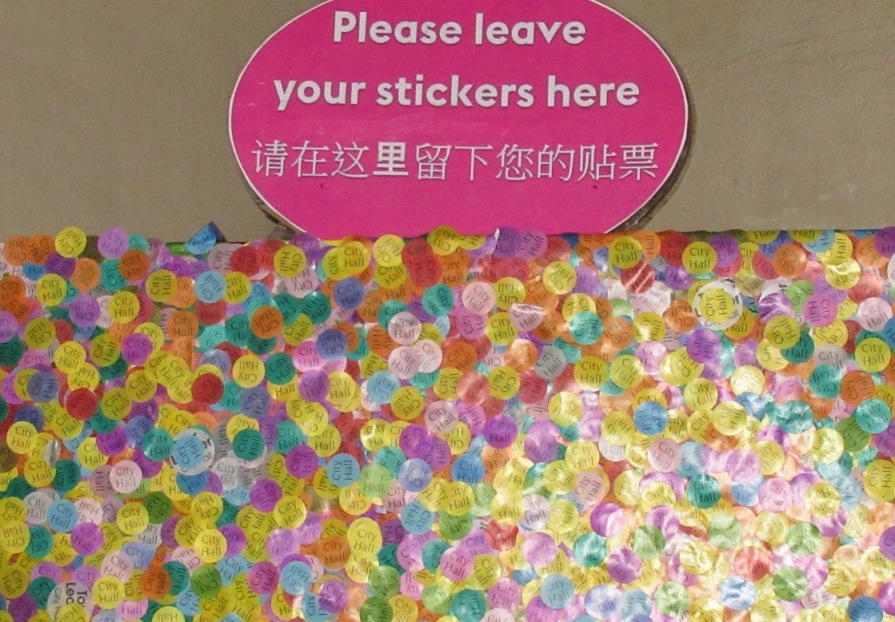
The society looked eco-friendly. Visitors of the City Hall were asked to return their stickers (to be used for tickets) at the exit for re-use.

The city is full of interesting designs and paintings. I found an interesting neon sign on the wall of the building at a corner. (See also the 3rd photo from the top)

In the subway stations, there are various paintings on the walls.

There are many things to talk about here.