2016-03-28

Iguana and lemur @ Nodai Biorium: March 26, 2016


I sometimes visit the Food and Agriculture Museum and neighboring “biorium” (space for natural animals and plants) of the Tokyo University of Agriculture in Setagaya ward during my walks.

I was lucky enough today as I met an iguana at a short distance.

It usually stays in its house about three-meter high from the ground. It walked on the walkway today.

Kids were shouting around it.

They also keep various lemurs in the biorium. Ring-tai l lemur is one of them.


A small one extended its arm through the open space of the cage. It was interesting.

They sell agricultural goods outside the facility. Relax.

Kusanagi, Nihondaira & Kunozan in Shizuoka: March 20, 2016


Shizuoka City has various historical spots and places of good view. I walked the hillside ways from Kusanagi Shrine through Nihondaira to Kunozan.

Kusanagi Shrine was built to enshrine Prince Yamato Takeru, a hero of ancient Japan. It is at the foot of hilly area. The statue of Yamato Takeru stood at the entrance.

The first gate locates about 1 kilometer from the shrine.

I moved up the mountainous road and arrived at Nihondaira. It is a plateau at the top of Mt. Udo. It is about 300 meter high.

People can enjoy the landscape of Mr. Fuji from here. It was unfortunately cloudy today and I could not see Mt. Fuji. There many tea fields on the side of the mountain.

I took the Nihondaira Ropeway which connects Nihondaira and Kunozan Toshogu Shrine in about 10 minutes. The shrine stood on the top of Mt. Kuno. (See also the seconf photo from the top).

It enshrines Tokugawa Ieyasu, the founder of the Tokugawa government in the early 17 century. The building is a national treasure. There were many tourists there.

There spread the Suruga Bay under the mountain. There are many vinyl plastic hothouses to cultivate strawberry and other fruits and vegetables.

A long stone-made stair links the shrine and the coastal area. It was pleasant to walk down the stair. (See the top photo).


2016-03-27

Traditional performing arts of Tohoku @ Zojoji Temple: March 12, 2016


Yesterday (March 11th, 2016) was the fifth anniversary of the Great East Japan Earthquake. More than 20000 people were killed or missing (including those who died of the damages caused by the disaster). About 170 thousand peoples are now forced to live away from their homes.

The Fukushima Daiichi Power Plant continues leaking wasted water. Sendai nuclear plant in Kyushu island restarted its operation. People’s interest in saving electricity seems fading.

It is the reality of Japan five years from the quake and nuclear accident.

Today, I visited Zojoji temple in Minato ward, central Tokyo to see traditional performing arts of Iwate Prefecture. The performances were organized as parts of the events to console the spirits of the victims of the disaster.

One of the performances was the Kanazu-school deer dance. They danced with deer masks and drams. (see the second photo from the top)

Another performance was sword dance. The players wore demon masks and danced with fans and swords. (See also the top photo)

They first played danced on the stage. Then, they walked in the garden of the Zojoji Temple.

The temple developed with the support of Tokugawa Shogun house about 400 years ago. The Tokyo Tower stands behind the temple.

A Buddhist monk prayed for the victims. The leader of Save Iwate, who support the event, burned incense for them.

The dancers prayed outside the temple building. (the thirs photo fro the top).


Local govt. facilities@ Hirakawa-cho: March 10, 2016


There are many governmental offices, including the Diet, Prime Ministar’s house, and ministries, in the neighboring areas westwards from the Imperial Palace. Thy have the buildings and facilities related to the local politics and the local governments at Hirakawa-cho and Akasaka-mitsuike district. I visited there today.

Many city governments have their offices in the Japan Municipal Building. 


Various information of the cities were displayed at the corner in the ground floor.

I had a short visit to the office of Shizuoka City. The office is used as an information center of the city in Tokyo. I saw various pamphlets in the office. The office is also used as a station of the local politicians when they come to Tokyo to talks with the central government, according to the office staff.

I also found the displays of 47 prefectural governments along the walkways to the Akasaka-mitsuke subway station.  (see the top photo). They emphasized the local foods, tourism and local football teams.

There are many construction works in the area. The Prince Gallery Hotel is scheduled to open in July. (see also the second photo from the top). 


2016-03-06

Spring Flowers and Birds: Feb 27-March 5, 2016


The season is turning from winter to spring. I walked around the parks and walk paths in western Tokyo in the weekend days of late February and early march.

I saw Japanese bush warblers (uguisu) on the branches of ume (Japanese apricot) trees. The combination of the bird and the flower is regarded as a happy couple.

The ume festival attracted many visitors in the Hanegi Park in Setagaya ward. The festival continued about a month till March 6th.


Yellow rapeseed flowers were open in the Roka Park. (See the top photo)

2016-02-11

Shizuoka’s wood exhibition @ Shinjuku: Feb. 11, 2016


Tokyo holds many events and exhibitions and I enjoy visiting them. Today, I called at an exhibition of wood products produced in Shizuoka Prefecture, which is famous for Mt. Fuji and locates 100-200 kilometers west of Tokyo.

Japan is a wood-rich country (about two thirds of the land is covered with forests), but it imports about 70% of total wood consumed. Recently, the local producers have begun to promote their products.

They emphasize that the quality of Japanese wood is high and  it has “the sense of warmth” in promoting the products; they did so in the exhibition.

Timbers as well as wooded products such as interior materials and floor materials are displayed. The staff explained the difference of quality with the imported ones.

A small cottage, a playground slide and several toys were placed in the kid space. The space was organized by a company which offers children and adults the opportunities to join various activities, such as camping and wood cutting, in the forests in Shizuoka.

There is a trend to use more wood (rather than concrete or other artificial materials) for interior materials in various buildings. The public gymnasium at Kusanagi in Shizuoka Prefecture is one example. It uses wood produced in the area. A big picture of the gym was displayed.

The future possibility was shown at another corner. Reduced-size models of multistory wooden buildings were displayed by a group of architects. It is now technically possible to build a wooden building of five stories or higher. Some experimental houses and buildings are being built in Tokyo and other places.

There were several specialists in the site; they asked questions to the staff.

The tea corner was also made by the local products.

The exhibition was organized by Shizuoka Prefecture in cooperation with the local industry associations and the companies. It is a part of moves to revitalize local economy.

Many efforts are made by local people for the purpose. Some ideas are remarkable. It is interesting to visit events and exhibitions and to find new ideas.


2016-02-07

Winter trees & Ume Blossom; February 7, 2016


It is the coldest season of the year in Tokyo. The temperature sometimes goes down under zero, and people wear heavy overcoats. However, the daytime is getting longer.

Today was a fine day and I had a walk around Setagaya ward, western Tokyo.

I saw tulip trees, ginkgo trees and other deciduous trees stood along the walk paths and in the park. The sky was very blue behind the trees.
(see also the second photo from the top).

The Ume or Japanese apricot flowers began to blossom in the Hanegi Park.
(See also the top photo)


They were in some temples and shrines, too.

I found a cat and parrots enjoying the sunlight.

It was a nice walk.


Sanriku Food Fair@ Shimokitazawa: Feb. 7, 2016


We will soon have the fifth anniversary of the Great East Japan Earthquake on March 11.

They held an event in Shimokitazawa, Setagaya ward, to sell the foods of Sanriku coastal areas. The areas are in Iwate and Miyagi Prefectures and were seriously hit by the tsunami disasters in 2011.

The areas included Rikuzentakata City, Ofunato City and neighboring areas. I visited there last October and November. There experiences there were so impressive. 

Please visit: 
Four and half years from the quake:Sanriku, Iwate; Oct. 31-Nov.1, 2015
Autumn Scenes @ Iwate Prefecture: Oct 31- Nov. 1, 2015

Oysters, noodle, and other local products were served. I remembered my travel, the scene of the region and the day of the earthquake and tsunami.


2016-01-03

Thailand: Dec. 27, 2015 - Jan.1, 2016


I was in Thailand in the year-end and new-year days and walked in Bangkok, Ayutthaya and Chiang Mai cities.

I visited Bangkok for the first time in about 15 years. I found big changes. There are many skyscrapers now. Construction works are under way in many places.

The traffic jam is still heavy, but the BRT (Skytrain) has been expanded in this 15 years and the subway (MRT) has been introduced. The Buses, taxies as well as three wheelers (tuk-tuk) and bike taxies ran on the roads.

There are many historical places to visit. I enjoyed the scenes from Chao Praya River. Mandarin Oriental Bangkok and other hotels stand along the river (second photo frome the top). The scene of the Royal Palace from the river was impressive. 

I visited several temples on foot including Wat Phra Kae and Wat Pho. Chinese tourists were everywhere. At Wat Pra Kae, the tourist groups took pictures in every two minutes.

The reclining Buddha was impressive in Wat Pho. The scope from the temple was also wonderful. (the top photo)

There stands a big red gate in front of Wat Suthat. They have many shops of Buddhist objects around the templs.

I enjoyed local cultures, too. Thai boxing is very popular here. I visited a boxing stadium and was excited with the matches.

Ayutthaya is about 80 kilometers north from Bangkok. It is a historic city. The capital of the Ayutthaya Dynasty was here and it was severely destroyed when the country of the Thai people was conquered by Myanmar in 1767.

The ruins of the castles and temples remain. (see also the third photo from the top)

The city was registered as a Cultural World Heritage site.

Elephants attracted tourists.

The city is about seven meter high from the sea level. It was suffered seriously by the flood in 2011. The signs of the flood remain in many places.

Chiang Mai locates in the northern part of the country. There are many temples in the city. I met many monks in Wat Chedi Luang and other temples.

The city was full of tourists (as Bangkok). There are shops and facilities for foreign tourist. I visited a second-hand bookshop of English books.

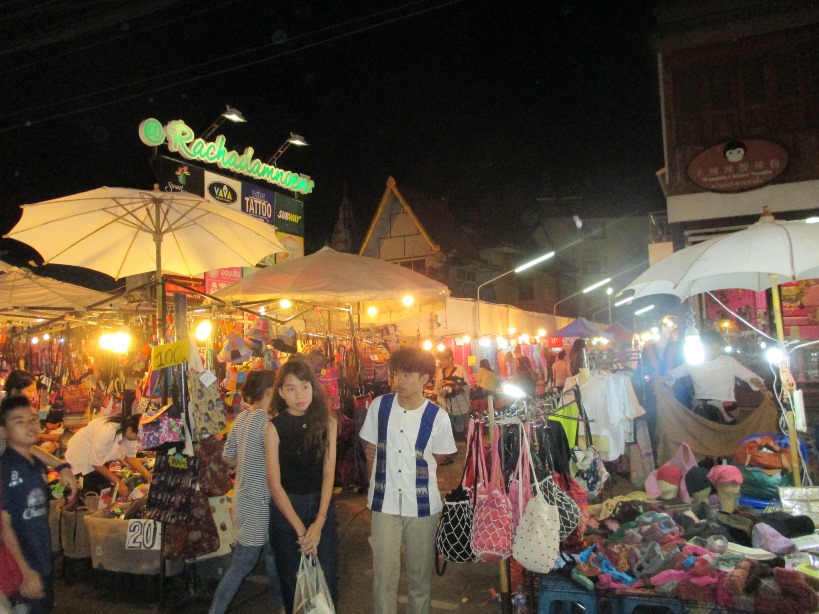
I also enjoyed the Sunday market held in the main street of the old town.