2025-06-18

Kanazawa; June 14, 2025


I stopped in Kanazawa as a base for visiting the Noto Peninsula region, which was hit hard by the earthquake last year. Kanazawa is the prefectural capital of Ishikawa Prefecture. During the Edo period, the Maeda clan, Japan's largest feudal lord aside from the Tokugawa Shogunate, settled here, and culture flourished in the region.


It's been nearly 10 years since I last visited here in 2016. The cityscape has not changed much. However, I found some differences from my last visit. Foreign tourists were more noticeable. I also found slogans praying for the recovery of the Noto Peninsula from the earthquake posted in various places.


The site of Kanazawa Castle is now a park. Some buildings have been restored. The park conveys the atmosphere of the Edo era. There were also many foreign groups, and the guide gave a detailed explanation. (See the top photo)


S
tone walls, fences, gates, and gardens were also impressive.


Kenrokuen Garden, adjacent to the park, is famous as one of the three most representative gardens in Japan. There are old trees remaining and the pond is beautiful. (See also the 2nd photo)


In the area west of the Kanazawa Castle ruins, samurai residences of the Edo period remain. Irrigation channels run through the city, and water flows abundantly.


Omimachi Market, about 10 minute walk from JR Kanazawa Station, is a marketplace filled with seafood and vegetable shops. It was crowded with locals as well as foreign and domestic tourists.


Kanazawa is famous for its traditional crafts, such as textiles, dyeing, and arts and crafts, and there are many shops and museums. In addition, the city is also enthusiastic about cultivating and promoting modern art. The 21st Century Museum of Contemporary Art, located near Kenrokuen, opened in 2004 with the concept of "an art museum like a park open to the town."


Sumo is popular in Ishikawa Prefecture. In the May tournament, Onosato, who is from the prefecture, won the championship and was promoted to Yokozuna. At the tourist information center at JR Kanazawa Station (the 3rd photo), there were photos of four wrestlers from Ishikawa Prefecture, including Onosato.

Toyama:June 13, 2025


I visited Toyama City in the Hokuriku region. After developing as a castle town in the Edo period, it has developed as the prefectural capital of Toyama Prefecture since the Meiji period.


I got off the Shinkansen at JR Toyama Station and moved to the transfer space in the ground floor. I found a tram platform inside the station building. From there, trams are connected to six directions. The transfers are very convenient. (See the top photo)


Japan now faces a decrease of population and many discussions are made on the issue. In such circumstances, Toyama City is drawing attention as an example of a “compact city”. To achieve the aim, the city has tried to develop public transportation such as trams, and has been encouraging people to live in the areas where public transportation is easily accessible.


Many LRT (light rail transit) vehicles are used for trams. They have features such as a low floor, quietness, and large windows. I actually rode it and it was comfortable. (See also the 2nd photo)


Toyama City is surrounded by mountains on three sides, the east, south, and west, and faces Toyama Bay to the north. Looking from the observation deck at the city hall, I could see mountains such as the Northern Alps behind the city. Unfortunately, today was cloudy and the views of the mountains were not so clear. (See also the 3rd photo)


The site of Toyama Castle is now a castle park, and a museum designed after the castle has been built. (Se also the 4th photo)


The New York Times selected Toyama as one of the 52 cities to visit in 2025. The first image shown in the introductory article was of the Glass Art Museum. The building, designed by architect Kengo Kuma, is used as a museum, library, and more.


The Jinzu River flows through Toyama City. The river once flowed through the center of the city and caused flood damages. Development work was carried out during the Meiji period, and it now flows in an area a little away from the center. 


Part of the former river is now a canal, and there is a park in the surrounding area that uses the canal.

2025-06-04

Shinjuku - redevelopment and foreign tourists : May 29, 2025


I walked around Shinjuku area in a while. I found two major changes –- redevelopments of the area and increasing number of foreign tourists.


Many urban redevelopment projects – including a plan in Shinjuku -- are under way in Tokyo.

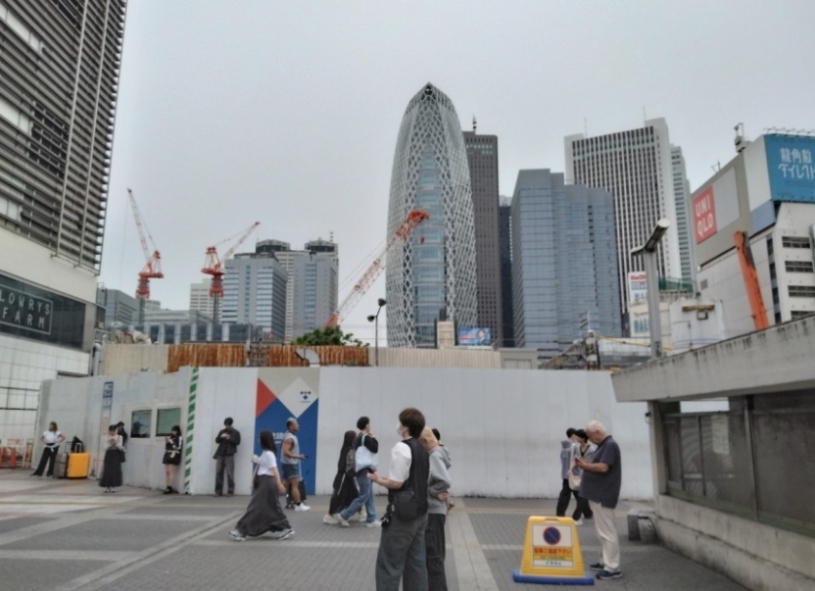
  The Odakyu Department Store building that stood above JR Shinjuku Station was demolished in 2022, and a new building is planned to be constructed by 2029. (See also the 2nd photo)


Redevelopment is also taking place around the station. Cranes are lining up all over the place. (See the top photo)


Some works are in progress inside the station. Some passageways and gates are closed and tentative ones are set. I found it difficult to find transfers in some places, and staff were directing directions.


The Alta building at the east exit of Shinjuku Station had a large display on the wall and was known as a cultural hub. This building was close in February 2025, and demolition work has begun. Redevelopment plans are under consideration. (The Alta building photo in 2021)


The number of foreign tourists to Japan is increasing. It reached a record high of 36.86 million people in 2024, and it is expected to exceed 40 million people in 2025.

  Foreign tourists were noticeable in Shinjuku as well.


The street in front of Toho Cinemas in Kabukicho was overflowing with foreign tourists. A guide was explaining things to group tourists, such as the Godzilla statue. (Se also the 3rd photo)


It seemed like there were more foreign tourists than Japanese people stopping at the east exit.

  The scenery in Shinjuku is changing every year.


2025-05-15

Koshu Kaido Walk (18) Kanazawa – Kamisuwa: May 11, 2025


Today I walked from Kanazawa, the 44th shukuba station from Tokyo (Edo), to Kamisuwa, the 45th and last station of Koshu Kaido.

Kanazawa is close to Aoyagi Station on the JR Chuo Line. Old buildings remain here and there along the Koshu Kaido. I found traditional inns and trading stalls.


The road passes through mountainous areas. The rice fields in this area are used to dry agar in winter. Chino City is famous for producing naturally produced agar. There was a large sign reading "Agar Village" in the rice field. (See also the top photo)


I walked for about two hours and reached the center of Chino City. There was a Shinshu Miso store on the side of the road, and a miso barrel was placed in front of the store.


There are many shrines along the road. Even small shrines often have four pillars at each corner in this region. Miwa Shrine, close to the center of Chino, is also surrounded by four pillars.


The Kamisha (upper shrines) of Suwa Taisha are located in this area, and the Maemiya (front shrine) of the Kamisha is in Chino City. The main shrine of the Kamisha is in Suwa City.

During the Onbashira Festival, which is held once every six years, giant cedar trees cut down in the mountains are transported to the shrine. One route passes through Chino City. On the way, the pillars with many people on them go down a steep slope. The place of the big downhill is maintained in the Kiotoshi Park.


I found a torii gate leading to Suwa Taisha Shrine in front of JR Chino Railway station..


The Yatsugatake Mountains looked beautiful from Kamikawa Bridge near the Kiotoshi Park. 


After walking for about an hour from JR Chino Station, the Koshu Kaido entered Suwa City. The Northern Alps looked beautiful from the road.


I continued walking and entered Kamisuwa shukuba station. Kamisuwa is a major sake brewing area, and there are many sake breweries along the Koshu Kaido.


2025-05-14

Koshu Kaido Walk (17) Tsutaki – Kanazawa: May 10, 2025


Having finished my walks in Tokyo, Kanagawa and Yamanashi prefectures, my Koshu Kaido walk entered Nagano prefecture. Today I walked from Tsutaki, the southernmost shukuba station in Nagano prefecture and the 43rd shukuba station from Tokyo (Edo), to Kanazawa, the 44th station. The distance is about 15 kilometers, and most of the area is in Fujimi-machi, Nagano prefecture.


The Koshu Kaido headed north-northwest through mountainous areas. The site of Tsutaki is now around National Route 20. 


The gate and walls of the main inn remain. The railroad was installed away from the Koshu Kaido in this area, and the shukuba became gradually quieter. 


The Koshu Kaido has turned to the national route in some places and has kept old situation in other places. Stone Buddha were seen at various points along the road. (See als the 2nd photo)


After walking for about two hours, I came across a huge solar power generation facility along the road. Fujimi-machi is known as one of the solar-panel clusters in Japan. They started to construct many solar plants in the 2010s becouse of long hours of sunlight in this region. There are now more than 1,000 solar power plants, both large and small.


In recent years, however, there have been disputes over the development of the plants as various conflicts between the developers and local residents have arisen. The town has begun to regulate construction.

In addition, there have been a series of incidents of copper cable theft from solar power plants nationwide. I found surveillance cameras installed at the plants. I also saw warning signs saying "under surveillance" on the fences. (see also the 4th photo)


As I walked further, I saw a huge greenhouse. This is the facility of the "Yatsugatake Mirai Farm," which is funded by the major food company Kagome and Fujimi-machi. Tomatoes are produced here and sent to Kagome's neighboring food factories.


After walking another hour, we came to the Misayama Godo Milestone. It is the 48th or 49th milestone from Edo, which is 192-196 km away. A large keyaki (zelkova) tree remains on the west side from the Edo period, and an enoki (Chinese hackberry) was planted on the east side in later years. This is the only place on the Koshu Kaido where a pair of mounds remain on both sides of the road. (See also the top photo)


The Koshu Kaido soon enters Chino City. There are many solar power plants in this area as well. JR Aoyagi Station is located just before Kanazawa shukuba station.