2017-08-31

Frankfurt, Bonn and Rothenburg – trips by train: August 25-27, 2017 (Off off Tokyo)


I traveled along the Rhein and other western parts of Germany by train.

The ICE (Intercity-Express) is operated by Deutsche Bahn. I found the train ran at more than 300 km/h between Frankfurt am Main and Cologne. It is so fast.

The ICE train also provided us good WiFi services. I took a photo of the Rhein in the train and posted it in my FB during my travel from Bonn to Wurzburg. The connection was good.

The local trains have spaces for bicycles, which enables German people use their bicycles effectively.

Frankfurt hosts the European Central Bank. (see the 2nd photo from the top).

While preserving traditional towns, the city have increased new skyscrapers in the last two decades.

The EU is shaken after the Euro crisis and Brexit. Still, the EU’s flags and marks are everywhere Europe. I wondered the future of the region ( and the world).

The Marien Platz, (public square) in front of the city hall remains the atmosphere of the middle age. I saw many tourists from China, Korea and other Asian countries.

People enjoyed a late summer day at the river banks of the Main River.

Bonn used to be the capital of Germany (West Germany). The capital was moved to Berlin in 1990 after the country's reunification.

The city had invited the U.N. institutions and other international organizations after the governmental offices left. The Bonn University has tens of thousands of students.

Bonn is famous as a hometown of Beethoven. I visited Beethoven house.

A festival was held in the city square. People enjoyed meals and drinks in front of the sculpture Beethoven..

It is impossible to talk about the tourism in Germany without referring to the Romantic Road and Rothenburg. It preserves the middle-age atmosphere.

I joined a walking tour guided by a "night watcher."He gave me good explanations.

The town thrived in the middle age as a transportation hub; it was hit seriously by the black death (plague) in the 14th century; it was occupied and many people were killed in the Thirty Years’ War in the 17th century; it experienced no significant developments in more than 200 years after the war, which resulted in keeping old buildings. The town was focused on as a good sightseeing place in the 19th century.

It attracts millions of tourists today. The Market Place, which is surrounded by historical buildings, is so wonderful.

It is not only the old towns which attract visitors. A world-famous Christmas-goods shop (Käthe Wohlfahrt) opened in 1977 near the Market Place. It was crowded with foreign tourists (even in August).

Germany is keen on environment and energy. I saw many solar panels on the roofs everywhere. I also found power plants in many places. (See also the 3rd photo from the top)

This photo was taken from a train, so the .reflection of light appears, sorry.


Stockholm, Sweden: August 23-35, 2017 (Off off Tokyo)


Sweden is a “advanced” country in many meanings. 

It is one of the most advanced welfare state; it is the first country to issue the bank notes and to establish the central bank; it hosts the world’s most prestigious awards, Nobel Prizes; it is one of the front runners in moving into the cashless society; it is one of most politically transparent countries.

I visited Stockholm, the country’s capital, for the first time in about 20 years.

Stockholm is built on tens of islands. We can see the sea from many places.

The sky was blue on August 24 and the scenes were so beautiful. (See also the top photo)

The old town is called Gamla Stan in Stadsholmen island. The Royal palace is here. 

The parliament locates nearby.


Exchanges of the guards are performed every day in the Royal palace. Many tourists gathered to see it.

Shops are along the stone-paved roads.

The Nobel Museum is in a building around the public square (Stortorget) in the center of the old town. It opened in 2001 commemorating the 100 years of the prizes. (See also the 2nd photo from the top)

The building is also used by the Swedish Academy.


Symbolic awards of each decade are displayed in the museum. They are:

- Rudyard Kipling (literature, 1907, with his book) for 1901-10
- The Red Cross (peace, 1917, with its logo) for 1911-20
- Frederick Banting and J.J.R. Macleod (physiology and medicine, 1923, with insulin samples) for 1921-30
- Carl von Ossietzky (peace, 1935, with his writings which criticize Nazi) for 1931-40
- Alexander Fleming, Ernst Boris Chain and Howard Walter Florey (physiology and medicines, 1945, with penicillin samples) for 1941-50
- William Shockley, John Bardeen and Walter Brattain (physics, 1956, with a transistor radio) for 1951-60
- Karl Ziegler and Giulio Natta (chemical, 1963, with a plastic bottle) for 1961-70
- Amnesty International (peace, 1977, with a report on Argentina) for 1971-80
- Mikhail Gorbachev (peace, 1990, with a piece of the Berlin Wall) for 1981-90
- Robert Mundell (economics, 1999, with a 2 Euro coin) for 1991-2000
- Willard Boyle and George Smith (physics, 2009, with a digital camera) for 2001-10

I also visited the City Hall. The banquet dinner of the Nobel Prizes Ceremony is held in the hall of this building. More than 1000 people are invited to the dinner.

There is a meeting room of the community government in the upper floor of the hall. The high transparency of the country’s politics is supported not only by the mind of the people to support the democracy, but also by the political systems which enables strong check functions of the power.

There are many reports on the country's move into the cashless society. Currency-GDP ratio is about 2%, one of the lowest in the world (Japan’s rate is about 18%).

Indeed, I saw many examples of the trends. Debit and credit cards as well as smart phones are used rather than cash for the payments. Even at the public toilet, we can pay by the card.

Still, that is not all. I was asked to pay by cash in the taxi from the airport to my hotel. I saw most tourists paying by cash in buying their tickets at the museum, souvenirs at the shops.

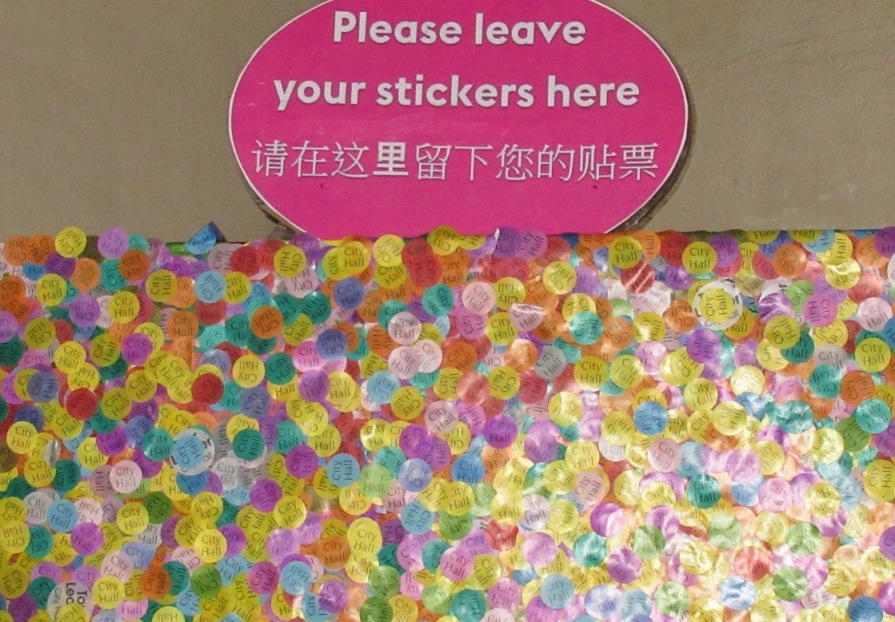
The society looked eco-friendly. Visitors of the City Hall were asked to return their stickers (to be used for tickets) at the exit for re-use.

The city is full of interesting designs and paintings. I found an interesting neon sign on the wall of the building at a corner. (See also the 3rd photo from the top)

In the subway stations, there are various paintings on the walls.

There are many things to talk about here.


2017-08-01

Various faces of Osaka: new business centers, traditional foods, town of the poor, and hate speech; July 29-30, 2017 (off Tokyo)


I visited several places in Osaka during my 2 day stay there.

Umeda is one of the busiest places in Osaka. JR Osaka and other railway stations including Hankyu, Hanshin and the subway lines, are there. New business and commercial facilities have been built and are being developed. 

Grand Front Osaka, which opened in 2013, is one of new landmarks. The walkways connect the facilities and the railway stations.

Umeda Sky Building is a skyscraper with an observatory at 173 meters high. I visited there. Many buildings as well as undeveloped places spread under my feet. (see the top photo)

I also visited Shin-sekai, about six kilometers south from Umeda. Tsutenkaku tower stands in the center of the district. 

We can enjoy the view of Tennoji and Abeno districts. I found Tennoji zoo below me. Skyscrapers are behind the zoo. One of them is Abeno Harukas, Japan's tallest building.

It is downtown with traditional atmosphere preserved. Various restaurants and gift shops are open along narrow streets. I enjoyed kushiage (fried vegetables and meat on skewer) in one of famous (but not expensive) restaurants. (See also the second photo from the top)

There spreads the airin district at the south of Shin-sekai. Many poor people live there. There are hundreds of cheap inns operating there. Even those who live on the livelihood protection in Japanese welfare system can stay in the facilities as the rents are low.

Many of them moved to the area decades ago to work as day laborers. They stayed there and got old.

There are various supporting services by the public bodies. Church and private organizations are also engaged in support activities. They regularly offer people the foods. There was a long line for the foods service at the public employment office when I visited.

The story is not simple.

The waves of the changes are arriving rapidly to the area. Skyscrapers, Abeno Harukas, started to emerge in the surrounding areas.

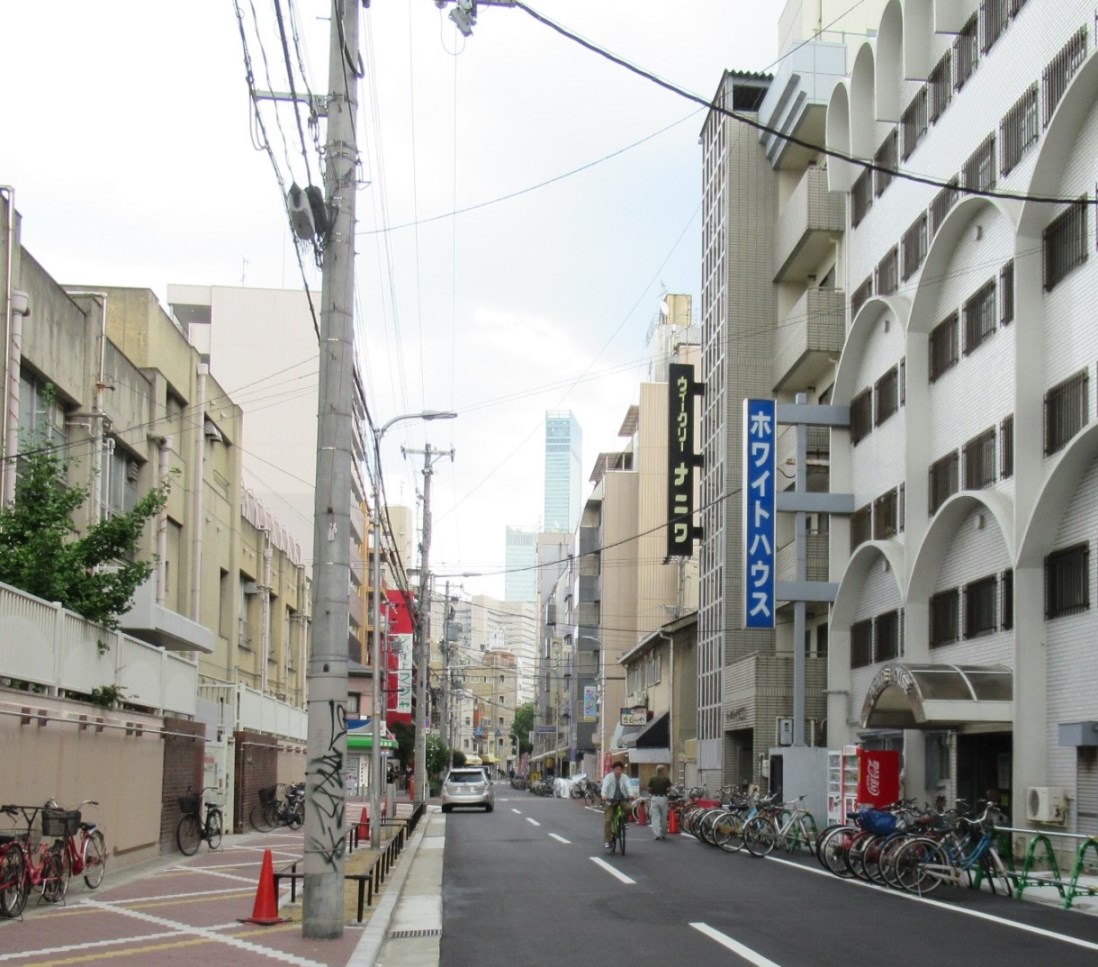
The combination of messy street and Abeno Harukas was impressive. (See also the third photo from the top)
Foreign backpackers have started to stay in the area and some inns have introduces WiFi services. 

I found hotels inviting foreign tourists and the recipients of livelihood protection service at the same time.


I
also visited Korean towns in Tsuruhashi, eastern part of Osaka. BBQ restaurants and other Korean shops gather there. Japanese and Korean cultures mix here.

At Umeda again, I met across hate speeches performed against the foreigners living in Japan. Such move became non-negligible in the last decade in Japan. 

Some citizens have begun to stand against hate speeches and related activities. At Umeda, there were groups who oppose to the speeches. (See also the 4th photo from the top)

Osaka is sometimes described “deep.” Indeed, it is. I experienced various aspects – prosperity, development, poverty, diversity, unrest, history and cultures – in my short stay.


Kofun (ancient mounted tombs) and towns of Sakai: July 29, 2017 (off Tokyo)


Kofun is a unique tomb of ancient Japan. The mounted tombs were built in the 4th to 6th century in the Kinki region - Osaka, Nara Kyoto and neighboring areas –and other parts of the country.

Many tombs gather in the southern parts of Osaka. The tombs in Mozu, in Sakai City, and the tombs in Furuichi, in Fujiidera and Habikino citires, are especially famous. The largest kofun is the tomb of Emperor in Mozu tombs in Sakai City, southern neighbor of Osaka City.

I visited Sakai to see the tombs and the towns.

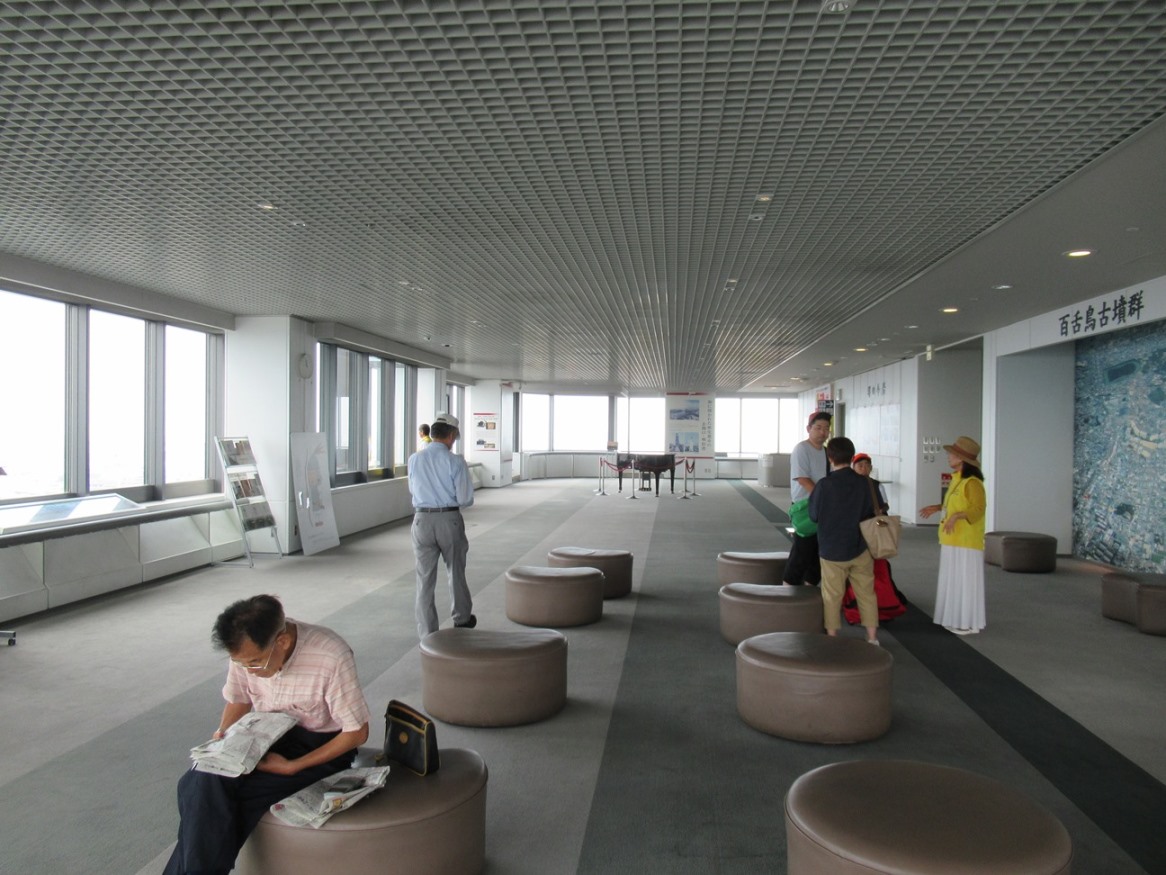
I first went up the observation room of the City Hall. It is 80 meters high.

Many kofun in the area was made in the style of “square at the front and rounded in the rear.” We can recognize the shape when we see it from 300 meters high or more (in the planes).

The shapes were not clear from the observation room. The looked like small woods. The picture is emperor Nitoku's tomb. (See also the top photo). 

Still, it was very impressive that many kofun scattered in the houses and buildings in the city. The photo is Emperor Hanzei's tomb.

There are 44 kofun preserved in the Mozu tombs.

There were volunteer citizens who provide information on Sakai and kofun. I had a talk with one of them for nearly one hour.

I walked around the city.

Emperor Nintoku’s kofun is 486 meters length and is surrounded by triple moats.

It is prohibited to enter the kofun which are believed to be ancient emperors’ tombs. A shrine stands in front of Emperor Nintoku’s kofun. (See the third photo from the top) 


There are walking paths arranged around the tomb. I saw citizens walking in the hot day.

I also visited Emperor Richu’s kofun.

It is the third largest ones in Japan.

I found news houses were being built around the tomb.

I also visited smaller kofun –Itasuke kofun and Goryouama kofun. Hundreds of houses stand around the tombs.

There was a plan to develop houses in the Itasuke kofun decades ago. The plan was stopped by the citizens7 opposition. The parts of a bridge, which was planned to use for house development, remain there.

Sakai is famous not only for its ancient history but also for its medieval and modern histories.

Sakai was the country’s largest free port city in the 16th century. Japan’s most advanced gun factories were built here. The technology was later used to develop metal products such as knives and bicycles.

Now, bile sharing services are available in Sakai.