2017-05-10

Nakasendo Walk (22) Midono (41/69)-Nakatsugawa (45/69): April 30, 2017


Nakasendo was also called Kiso-Kaido, as the Kiso Valley was the hardest-to-walk place in all route from Edo (Tokyo) to Kyoto. There were 11 shukuba stations in Kiso – starting from Niegawa, the 33rd station from Nihonbashi, to Magome, the 43rd station.

I completed the walks through the 11 Kiso stations today.

Today’s walk started from Midono, the 41st station. There were many tourists who walks from Midono to Tsumago, the 42th station. I enjoyed beautiful flowers while walking.

Tsumago is one of most famous and popular shukuba stations in Nakasendo. They started preserving and rebuilding old houses in the 1960s. The atmosphere of the Edo era remains. Now the place is widely known among the tourists in the world. There were many foreign tourists here. (see also the 2nd and 3rd photo from the top)

Kiso area has a long history of forestry. There were various conflicts between the rulers and the ordinary people over the use of forestry resources. Such memories were displayed at the historical museum.

There was a craft man who wrote names, wishes and other information on requests on the wood-made horses in the welcome center of Tsumago. It was unexpectedly cheap. I got it for my souvenir.

The services of the people to welcome tourists, or the software infrastructure of tourism in other words, are wonderful in Tsumago  --  I got such impression here. 

Nakasendo goes into mountainous. I went through the Magome Pass before arriving in Magome, the 43rd station.

There is an observatory space just before entering into Magome station. I saw Mt. Ena and other mountains.

The old town is also preserved and/or rebuilt in Magome. There were many foreign tourists.

Magome is the birthplace of Shimazaki Toson, one of great novelists in the Meiji era. His work “Yoake mae” (Before dawn) focuses on the moves in Magome and other Kiso areas at the end of Edo era and the beginning of Maiji era. The conflicts over the forestry resources (and the suppressions on people by both Tokugawa shogunate government and the Meiji government) were described in the novel.

The place of the main inn (honjin) is now used for Shimazaki Toson Museum.

I walked about 2 kilometers from Magome and found a monument, which tells “Kiso-ji (Kiso road) begins here, goes northwords.”

There is a stone-paved road between Magome and Ochiai, the 44th station. The area is called the Ju-Magari Pass (the passes of ten corners).

I arrived in Ochiai. It was a small shukuba. The gate and other parts of the main inn were preserved.

I moved westwards through a hilly road and arrived in Nakatsugawa, the 45th station.

It was a long walk –nearly 30 kilometers – today.


2017-05-05

Nakasendo Walk (21) Okuwa-Nojiri(40/69)-Midono(41/69): April 29, 2017


I resumed my Nakasendo Walk from Okuwa, between Suhara, the 39th shukuba station from Nihonbashi and Nojiri, the 40th station. It is about 20 km walk.

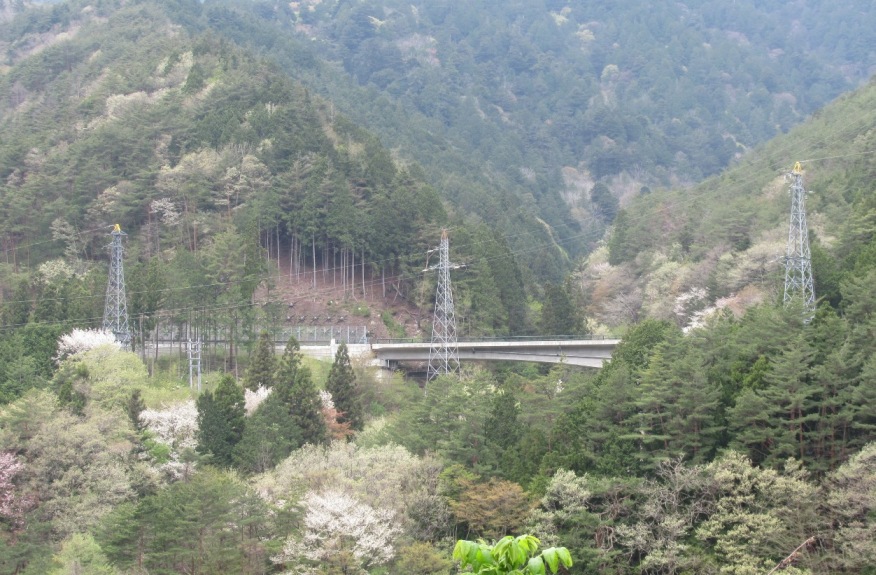
I saw various beautiful flowers during my walk. I also found dams and hydropower stations in and along the Kiso River. The signs of flood disasters were also notable in the area.

The hana peach flowers were beautiful when I got off the train at Okuwa station. The tree was originally imported from Germany about one hundred years ago by Momosuke Fukuzawa, a famous businessman who developed hydroelectric industry in this area in the Maiji period. I found the flowers in many places -- along the roads, the river banks and in the house gardens – in the Kiso Valley.

Nakasendo goes along the Kiso River. I saw the mountains of Chuo Alps behind local mountains. The scene was beautiful.

I arrived in Nojiri shukuba station. There remain several old houses.

There stood a bord sign of “west end” in front of a house at the western end of the streets.

There is a cow shed along Nakasendo near the sukuba station.

I also found tea fields here. Farmers pick up the fresh tea leaves in May in Shizuoka and neighboring areas which face the Pacific Ocean. Here in Kiso, they pick up the tea in June, a month later.
.

There is a big dam named “Yomikaki Dam” near Nojiri station.

I walked along the river. The river, the road and the railway go together in a narrow valley. (See also the third photo from the top)

I arrived in Midono station. They had a big fire in the Meiji era and most houses were burnt. There is an office of the forestry association at a place where the main inn, or honjin, located.

There remain memories of Momosuke Fukuzawa in the area. A bridge was built when he was here about one hundred ago to carry materials necessary to build dams. It is preserved well.

It was just before the May festival. Tens of carp-shaped streamers were flying at the side of the bridge.


I crossed the bridge.


Fukuzawa built seven dams in the Kiso River in the Meiji period. We have now more than 30 dams. They transmit the electricity to the Kansai area.

His house has turned to a museum.

There are big rocks and stones around the museum and neighboring houses. The rocks were brought from the mountains when they had flash floods.


2017-04-21

Fresh green and spring flowers in Tokyo; April 15-16


The cherry blossom season is finishing. Now, it is the time to enjoy fresh green and various spring flowers in Tokyo.

I had walks in several places in western Tokyo.

The ume (Japanese apricot) trees and the gingko trees now have very fresh leaves in Hanegi Park in Umegaoka. They grow so rapidly. The scene changes day by day. (seee also the top photo)

The tulip trees open new leaves in Kitazawa walking paths. (See the 2nd photo from the top)

The maple trees and others show fresh green at Gotokuji Templs.

There are Japanese zelkova trees in Setagaya Shrine.

There are new grasses grow in the ground. Moss phlox flowers were open in some walking paths.

Various colors of tulip flowers were open at Gotokuji railway station.

Some cherry flowers are still open.

People enjoyed picnic at the side of green grasses and under a cherry tree.

The season is changing from spring to early summer.

I found ducks moving in the creek along a walking path. The fallen cherry flowers were flowing on the water.

The azalea flowers were open around a pond in Enjoin temple.


2017-04-13

Cherry blossom@ Chidorigafuchi, Off Imperial Palace, April 6, 2017


The cherry blossom is extraordinary this year in Japan.

Cherry usually opens from southern part of Japan, usually Kyushu and/or Shikoku; and the cherry blossom front moves up to north. This year, however, Tokyo’s cherry opened earliest in the country.

It is explained due to unusual weather this winter, including warm winter and cold March in southern Kyushu area, throughout the nation.

Tokyo’s cherry became full open on April 2nd.

I visited Chidorigafuchi, one of the most popular cherry blossom spots in Tokyo. It is a part of moats of old Edo Castle, which has turned to the Imperial Palace.

Hundreds of cherry trees were fully open.

Thousands of people were enjoying hanami or flower watching.

They walked along the street. (See also the 2nd photo from the top)

They watched the scenes from the observatory.

The visitors included the old, the young, kids, Japanese and foreign tourists. (See also the 3re photo from the top)

People made a long queue to ride the boats. The boats moved slowly under the pink flowers. (See also the top photo)


With the cherry blossom, we recognize that "it is spring."