2016-12-29

Life and society in Okinawa: Dc. 28-31, 2016


During my stay in Okinawa, I saw various aspects of people’s lives and society of Okinawa.


Naha’s Kokusai Dori street is the busiest shopping area in the city and in Okinawa. Pine trees are planted in the sidewalks of the 1.6 km street. Souvenir shops sell traditional crafts as well as interesting goods with new ideas. Restaurants serve local foods and Okinawa music shows.


There is a public market near the street. Tens of meat and fish traders hold their businesses there.

I saw so many Chinese, Taiwanese and foreign tourists in the street and market. Some shops have duty-free corners to attract foreigners. I met many fish traders who spoke native Chinese in the market.

Tourism is a major industry of Okinawa. One of the most rapidly developing areas is increasing foreign tourists. I recognized the trend.

Okinawa is famous for its sugar cane. I saw sugar cane fields in many places. 

They have flowers at the top in the season.
(See also the photo 2nd from the top)


The harvest has just begun.

Many musics are made on the sugar cane. Some of them bring the memory of the war in them.


Many other vegetables are grown in Okinawa. I saw some of them at a farmer’s market in Itoman, southern neighbor of Naha. “Made in Okinawa” was stressed.


They also sold small dishes of sea food in the neighboring fish market.

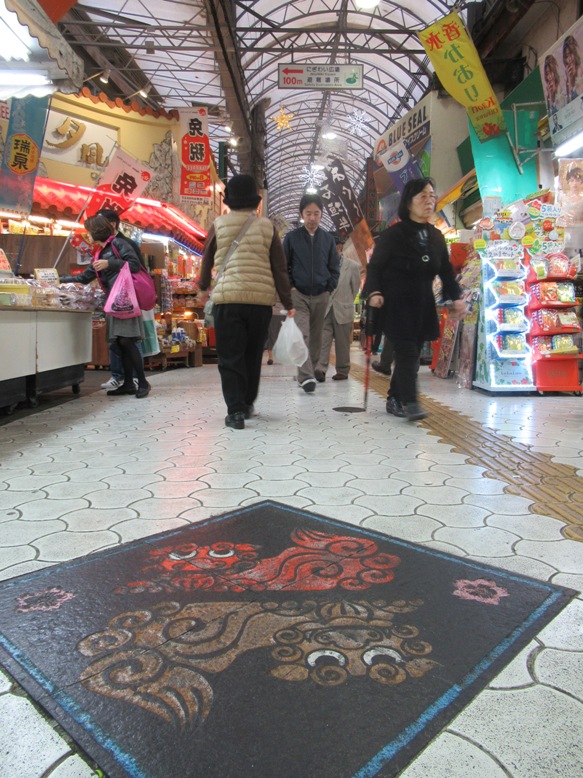
Shisa, lion-shape decorations, are found everywhere in Okinawa. It is believed to guard people from evil spirits.

Some of them are sculptures and some are painted. They are on the top of the roofs, at the gates of the houses and shops, on the roads and in the showcases of the stores.

I found a paint of Shisa in the market street near Kokusai Dori (See the 3rd photo from the top).


Most new houses are concrete-made to prepare for typhoons. They have water tanks on the floors as Okinawa had water shortage till a decade ago.

Tomb is important in Okinawa as they keep the tradition of ancestor worship. I saw many big and decorated tombs along the roads. The relatives gather at a tomb to pray for their ancestors in spring. 
People especially enjoy music and dances here. The restaurants hold Okinawa song performances in many restaurants every night at Naha’s Kokusai Dori street and in other areas. Okinawa’s song is accompanied by sanshin (three string) guitar. Eisa dance is performed in many places.

School boys and girls widely learn dancing, playing the sanshin, and other traditional performances. Private dancing school is also popular. I found groups of such kids showing their performance in the American Village shopping complex in Chatan town, north of Naha. (See the top photo)


Must-see places in Okinawa: Dec. 28-31, 2016


I stayed in Okinawa to enjoy my year-end holidays. There are several must-see places in the main island of Okinawa. I visited some of them. 

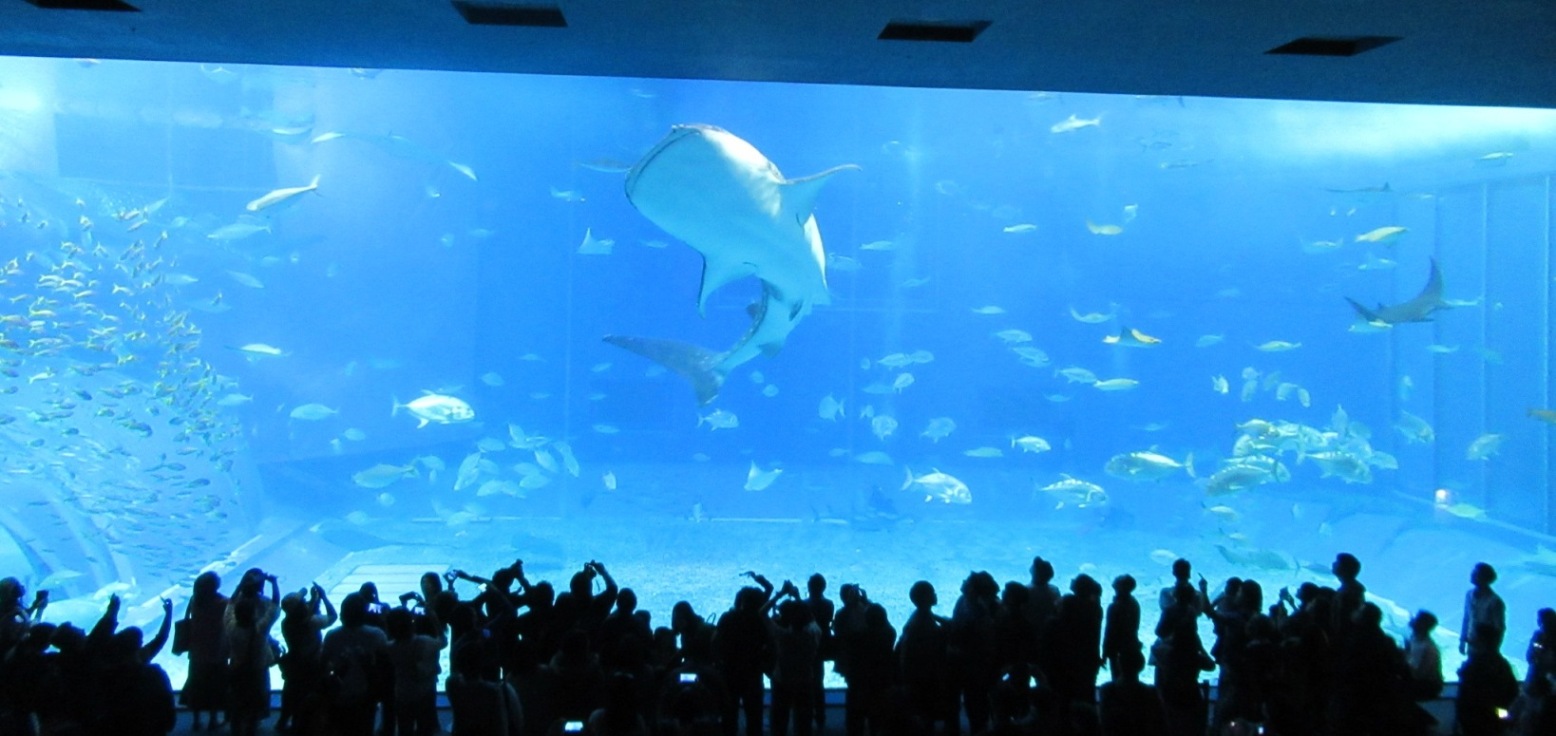
Okinawa Churaumi Aquarium is one of the leading aquariums in the world. The largest tank is 7500 cubic-meter large (or 35m x 27m x 10m). Two whale sharks of 8 meters and 7 meters, respectively, live there with many other kinds of fish. (See also the top photo)

It attracts many tourists. I found many Chinese, Korean and other Asian families.

They have other 76 tanks. 

Kids were enjoying touching asteroids and watching huge lobsters. (See also the photo 2nd from the top)

Jerry fish were swimming slowly. 

They also offered dolphin shows. I felt people really enjoying.

The Shurijo Castle, in the eastern outskirt of Naha, was the capital of Okinawa’s medieval dynasty. The dynasty was established in the 15th century, became under control of Japan’s Shimazu region (Kagoshima Prefecture now) in 1609 and was completely merged into Japan in 1879. (See also the 3rd photo from the top).

The castle was completely destroyed by the U.S. force in the second world war. Main buildings were rebuilt by the 1990s. The castle registered as a world heritage site in 2000.

Okinawa has been an intersection of trades, people’s moves and communications of the cultures. The displays in the castle show various examples of the facts.


I also visited the Nakagusuku Castle in the east coast of the island. It is one of the historic castles of the medieval dynasty era. The group of castles were registered as the sites of the World Heritage in 2000. The Pacific Ocean lies behind the castle.

Sefa Utaki in the southeast coast of the island is one of the holy places of the region. The goddess came down here and created Okinawa, according to the legend. 

A female was chosen as a communicator with the gods and goddesses in the old days. They communicated with the gods in holy places including Sefa Utaki. It is also registered as a world heritage site.

A small sacred “kudaka” island is seen from the place.

There are many small islands around the main island. One of them is Kori Island. 

Their lives have changed after a bridges was completed. Now, there are many tourists to Kori Island.

The scene from the observatory tower was wonderful.

So were the displays in the shell museum. 


2016-12-25

Winter Scenes in Western Tokyo: Dec. 25, 2016


Tokyo had a snow on November 24th for the first time of November snow in 54 year. The climate was milder in December. I had short walks in various places in western Tokyo almost every weekend.

The ground was covered with new fallen leaves in the Roka Park when I visited on Dec. 24.

Dogs were joyfully running around the yard in the park.

The Japanese zelkova trees were bald in the park in front of Baji (Equestrian) Park in the middle of December. Families enjoyed their walks.

The cherry trees were bald along the Kitazawa river walking path on Dec. 25.

The grass was dry around the pond in the temple near the path. However, I saw some flowers open.

With Christmas being over, Tokyo is entering into the new-year season.


2016-11-27

Singapore: Nov. 21-26, 2016


I visited Singapore for the second time in a year. I reaffirmed that the city was modern and clean.

Many tourists gathered around Merlion in the Marina bay area. The huge Marina Bay Sands Hotel stands in the opposite side of the bay. (see also the 2nd photo from the top)


Skyscrapers such as the Marina Financial Center buildings are also around the bay.

You can enjoy the scene of the port as well as the marina bay from the higher floors of the skyscrapers.


Modern shopping mall is also built in the area.

The scene of Marina Bay Sands Garden is always impressive for me. It reminds me of the scene of Science fiction movies. (see also the top photo).

Singapore is a multicultural city. Chinese, Malay, Indian, Western and many other people live here.

There are temples of Islam, Hindu and Buddhism in the South Bridge street in the central area.

Monuments are made in the China town. They tell us the history of Chinese immigrants in the past.

I saw people enjoying drinks and talks after business hours at the restaurants along Singapore River. 

The statue of Sir Thomas Raffles, who contributed building the city as U.K.'s colony in the 19th century, stands at the side of the river.  


2016-11-20

Kuala Lumpur: Nov 20, 2016


I visited KL for the first time. 

I saw many success and challenges for the development in the country. Diversity in culture, race and religion is another point I felt strongly.

The express from KL international airport, which locate about 50 km south of KL, to KL central station was excellent. It connected the two point in 28 minutes. The rout is straight. The airport as well as the railway are surrounded by the palm tree forests.

The transport infrastructure is good in KL. There are over railways as well as light rapid transit systems and a monorail. 

The roads and highways are well developed.

Comparing with Jakarta’s heavy traffic jam, I reaffirmed Malaysia’s development. The country’s GDP per person is more the 10,000 US dollar, the level of middle-income country

The twin tower of Petronas was massive and impressive as had expected. 

People enjoyed their holidays in Taman KLCC (KLCC park) just under the towers.

The towers are also seen over mosques-style building from Merdeka Square, near the birthplace of KL. (see the top photo)

There are many modern shopping malls in the Bukit Bintang area.

Old areas remain. Some buildings have already become old. I saw construction works to redevelop old areas and buildings in many places.

When we talk about the middle-income trap, Malaysia is often examined. I wondered how the scenes

There are many races – Malay, Chinese, Indian and so on – in Malaysia. There are Islam, Buddhism, Christianity, Hindu and other religions believed here. It is diverse in culture, too.

The shops at Bukit Bintang were decollated with Christmas trees. Moslem people took pictures in front of it.  (see the 2nd photo from the top)

The china town was crowded with Chinese, Moslem, foreign tourists and many other people.

I visited open-air restaurants in the Alor Street. I found they served Chinese, Malay, Thai and many other foods.