2015-12-01

Jakarta: Nov.29-Dec.4, 2015


I came to Jakarta for the first time in about 18 years and walked around the city. A mask was indispensable to prevent the dirty air from coming into my body.

I found dramatic changes of the town. The city was full of energy for development, and messy.

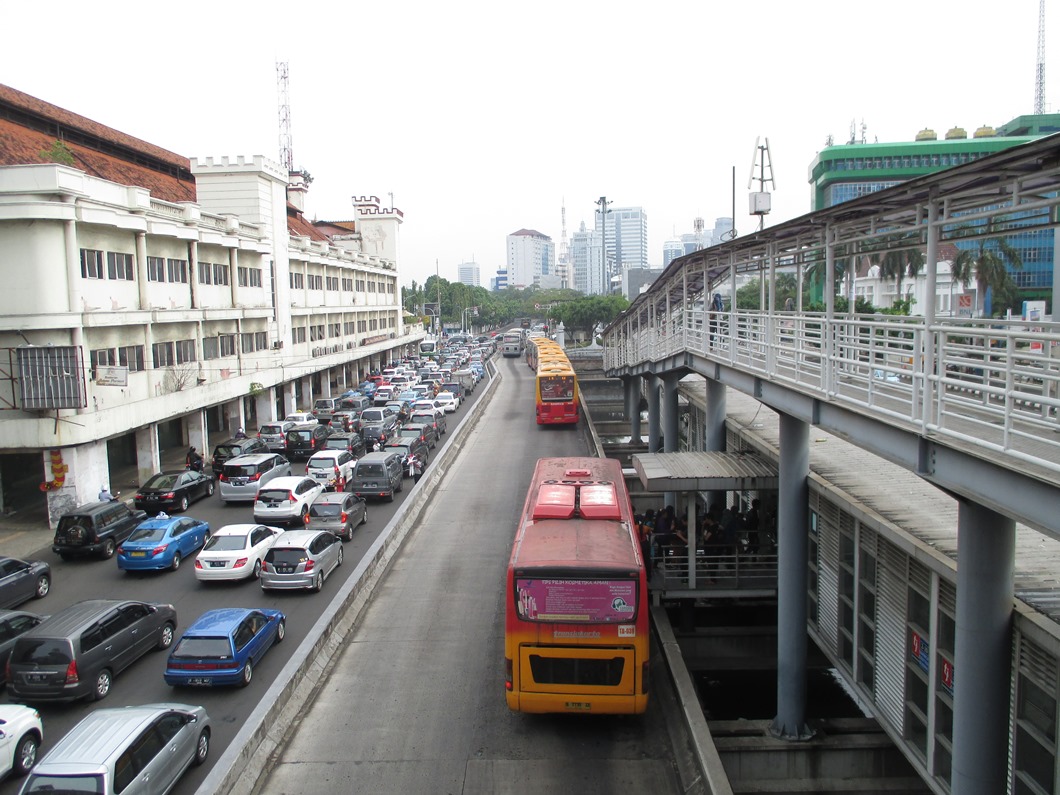
Skyscrapers, traffic jam, motorbikes, air pollution, busway, and mobile phones are among the keywords which symbolize current situation of the metropolis.

Jakarta was huge but flat in my memory 18 years ago. Now, there are hundreds of skyscrapers in many districts in the city.
The buildings are not only tall, but also massive.

Constructions are under way everywhere. 

In addition to the buildings, works to make transportation system (Mass Rapid Transit, which includes subway) are being conducted.

There remain old houses around the modern skyscrapers (see the top photo). 

The sidewalks are full of holes.
The water remains long on the road after the rain. 
The canals are dirty. The contrast between the new and the old is impressive.

Traffic jam is heavy. It took more than 15 minute to move a bloc by taxi. There are so many motor bikes (like other Southeast Asian nations) and three wheelers (the also second photo from the top). 
Jakarta does not have its subway system so far (it is under construction). Instead, they have the "busway" system. I took on it (see also the third photo from the top).

The air pollution is mainly caused by the emission of the bikes and cars, not by the haze here in Jakarta. I had a headache when I forgot wearing a mask on my mouth.

I found the development of the middle class. The new shopping centers in central Jakarta are large and spacious. They attracted many shoppers. I found the prices of the goods and foods were as expensive as those in Tokyo, but many customers were enjoying their shopping and meals.
I saw the customers making lines to make their shopping cards in the “Plaza Indonesia”, one of the leading shipping malls.

There are shopping centers for less rich people, too. I visited one of them in the northern part of the city. Many goods were displayed in narrow spaces. The prices of the goods were lower. The prices were much lower in the open-air stalls outside.

The gap between the rich and the poor is widening, which makes a problem as economy rapidly develop.

Families enjoyed their holidays in the Murdeka Square, central Jakarta. They took pictures in front of the 132meter-high Monas monument, which commemorate the independence.

Hundreds of people gathered in the Fatahillah Squre in Bativia, northern part of the city. The area is the birthplace of Jakarta. Old Dutch court stands at the side of the square. The first construction of the Bativia CIty was in the early 17th century or about 400 years ago.

The mobile phones were used every where.

The Japanese pop culture was popular, I found. JKT 48' s theater is in a commercial building in Senayan, southern Jakarta. I also found various Japanese characters used in the packages of food products even if the products were not made by Japanese companies.


2015-11-02

Autumn Scenes @ Iwate Prefecture: Oct 31- Nov. 1, 2015


During my visit to the places to see how reconstruction efforts are being made, I enjoyed the autumn scenes of Iwate Prefecture.

It was the season of autumn color. The mountains changed partially to red and partially to yellow.

It was nice days and the sea was blue.

At Sanriku Station of Sanriku Tetsudo railway, they dried persimmons. 

People wrote their wishes in on the scallop shells and left them at Koishihama station.

They run a steam locomotive train in the weekend. My tourists bus ran side by side with the SL train. It was an exciting experience.

There is a shopping place with old-fashioned atmosphere in Machiya-Monogatari facility in Morioka City. The goods produced by Save Iwate and other NGOs engaged in the reconstruction works are sold there. I tasted walnut-flavored soft cream in the store.


Four and half years from the quake: Sanriku, Iwate: Oct. 31-Nov.1, 2015


Four and half years have passed after the Great East Japan Earthquake. I, with my colleagues, visited the Sanriku Coast area of Iwate Prefecture, where the tsunami disaster made serious damages.

We moved up from south to north: Kesennuma (Miyagi Prefecture), Rikuzentakata, Ofunato, Kamaishi, and Otsuchi.

The works to hike the level of the lands were under way in many places. The scenes were impressive. (the left photo was taken in Otsuchi Town).

The roadside rest facility in Rikuzentakata was heavily destroyed by tsunami on March 11, 2011. (the top photo) 

Many people were killed here. We received an explanation from a local guide (who was also hit by the disaster) in front of the preserved building. The tsunami reached 14.5 meter high here.

The coast were covered with thousands of pine trees. All but one trees were washed away. The miracle pine tree was judged dead after several months, and the shape was preserved after having artificial treatments. It attracts tourists.


The city decided to develop new residential areas in the elevated lands and in the hilly areas. The lower lands are planned to be used only for public spaces and business purposes. Construction machines were moving everywhere.

Giant belt conveyors were used to carry the soil collected in the mountain to lower lands. The operation was over in September, but they still remained.

Many things remain unclear. The biggest question might be whether the residents return to the area when the works are completed.

A dome farm has been developed outside the central city. They produce lettuce here. 
Many temporary prefabricated houses and stores still remain in many places in the area. The shopping area in Ofunato is one example. This place will stop the operation shortly as new supermarkets and shopping houses have been built nearby.

We rode a railway from Koigahama station in Ofunato city to Kamaishi station. The railway got a heavy damage in the quake and recovered in 2014.

The train was presented by the Kuwait government.
There is a factory of Nippon Steel & Sumitomo Metal just in front of Kamaishi station. The city developed with the steel maker. With downsizing of the factory, the population of the city decreased in decades. The earthquake and tsunami disaster hit the area in such business conditions.

Unosumai area, north from central Kamaishi, was severely hit by tsunami. A new rugby stadium is planned to be built to hold matched in 2019 in the Rugby World Cup.

Otsuchi Town got serious damages by tsunami. The mayor (town manager) as well as many town staff was killed. There are many public servants sent from the local governments throughout the nation working here.

The damaged town office still remains. The opinion spreads whether or not to preserve the building.

A reconstruction plan was made. The works to make new elevated lands, roads and other facilities have already started. Again, there remains a big question: whether people will come back even after the completion of the construction works. The question seems deeply related to the basic policy of rural developments.

The signs to show the tsunami and earthquake information were everywhere.

The situation is still hard and it is not easy to reconstruct the areas – this is what I honestly felt in Sanriku Coast. 

I reaffirmed the efforts made by many people of local communities, NGOs and other institutions in private and public sectors.  I saw many smiles of the people in the hotels, restaurants, shopping stores and other facilities, that was good.


2015-10-29

Kaido book & coffee @ Shinagawa: Oct. 25, 2015


As follow-ups of my Tokaido Walk from Tokoy to Kyoto, I sometimes visit spots around Tokaido. I called at “Kaido book & coffee” in Shinagawa.

The shop opened late summer this year. It is both a café and a bookstore. The door is open towards the old Tokaido street in the ground floor. There are about 10 thousand books in the second floor.

The space is often used for the events related to Tokaido and travels.

Shinagawa was the first shukuba station from Nihonbashi, the starting point of the about 500 kilometer Tokaido route to Kyoto, and had nearly 100 inns in the Edo period (1603-1867). The road here has converted into a shopping street.

I saw a ukiyoe picture drawn used in the protection wall of a construction site. The original was drawn by Utagawa Hiroshige, a famous painter in the Edo era. The ukiyoe tells us the scene around here about 200 year ago.

The local community is trying to make good use of the traditional Shinagawa shukuba station to activate the area. The signboards of historic places as well as the visiting center have been built. I saw many flags of the shukuba station at the side of the street.

The new book &coffee shop is another attempt to play up Tokaido.

I enjoyed a cup of coffee.


2015-10-19

Yahiko Village:October 18, 2015


I visited Yahiko village near Niigata City during my stay in Niigata Prefecture.

The village is famous for Yahiko Shrine, the most prestigious shrine in Niigata Prefecture. It is not sure when it was built, but it is surely very old. People worship not only the shrine itself, but also the mountain behind (Mt. Yahiko). It is believed that the mountain is the god.

Current main building was built in 1816 after a fire and they have the 100th anniversary ceremony next year. Seeing it, series of events are being held.

I visited Yahiko with a special train planned for the events. The welcome plates and flags were waiting us. A traditional drum performance was also played.

There are shops, restaurants and hotels at the sides of the roads from the station to the shrine. They have natural hot springs, too. The village attracts about 2 million visitors every year.

It was not only the tourists. Many families were there to celebrate the kid’s health at the age of three, five and seven. 


They have a chrysanthemum festival next month and local people were doing preparations.

I climbed up the mountain by a ropeway gondola. It is 634 meter high. (see the top photo. The mountain locates behind the main shrine building)

The leaves were changing the colors.(3trd photo from the top) 
I could see the Sea of Japan in the north from the mountain.
The Echigo Plane spread in the south. It was a good autumn day. (see also the photo second from the top).

I walked down the mountain. The road was steep.

There are about 8200 people in Yahiko Village. Unlike many other small villages, it has kept independence. In addition to tourism, it has bicycle race and produced agricultural goods – rice, vegetables and fruits. Various cultural activities are being planned.

I have visited many small villages in the local area and have seen the problems behind them. At Yahiko, got the impression that the village was more active and open-minded than I had expected before visiting there.


Niigata Prefecture: Oct. 17-18, 2015


I visited Niigata Prefecture, about 200-300 kilometers northwest from Tokyo. It faces the Sea of Japan and there are much snow in winter. Its production of rice is the biggest in Japan. It also produces good sake (Japanese wine), various sea foods and vegetables.

The harvest of rice had just finished wen I visited there. The rice fields were dried up, but they were indeed wide. (The photo was taken near Niigata City). 


The Shinano River flows across the Echigo Plane. The picture was also taken in Niigata City.

The prefecture saw a rapid development of infrastructure – highways, high-speed train system (Shinkansen), river projects etc. – in the last half century. It owed a lot to former Prime Minister Kakuei Tanaka (He served as a premier in the early 1970s).

I visited Uonuma City and Minami-Uonuma City, both locate in the southern part of Niigata prefecture. Most areas are mountainous here. Still, the roads are well developed.

The condition is hard in the winter time. They have more than three meters of snow in the area. Most houses have garages made of concrete in the ground floor. The snow covers the floor. People live in the 2nd and 3rd floors. The roof is steep to fall down the snow.

I found the roads in the rice fields well developed and straight. They produce Uonuma brand koshihikari, one of the most prestigious rice brands in Japan.

The roads go through the walls of snow in the winter season.

The statue of former PM Tanaka (covered with a roof to prevent snow) stands in front of the Urasa Station of Joetsu shinkansen or bullet train in Minami-Uonuma City.

Uonuma’s efforts to develop a better medical-nursery service attract attention of the nation. The doctors, nurses, care works and other persons in the health services are trying to have good communications and to provide the best possible services. It is known as “Uonuma” model. The achievement is remarkable especially in the prevention and the control of diabetes.

I visited a local clinic in Suhara district, about 20 minute drive from central Uonuma city. I thought many things there – the doctor’s efforts, the problem of the local community in the mountainous area, the country’s medical and care system, the politics, the happiness of the people and many others ….