2014-05-12

3 years after the quake @ Iwate (off Tokyo) : May 10-11, 2014


Three years and two months have passed after the Great East Japan Earthquake. I visited Iwate Prefecture.


The rubble has been removed. The roads, railways and houses have been rebuilt one by one. NGOs, individuals, private companies as well as the local governments are making efforts to restore the regions.


Still, many people live in temporary houses and face difficulties to find jobs. The process to rebuild disaster-preventing towns is slow. The prospect for the tigion's reconstruction and future development is not yet clear.


>> Miyako City

I took off the Tohoku Shinkansen (bullet train) in Morioka, the prefecture's capital, and moved to Miyako City in the Sanriku Coast area.

Miyako locate at the mouth of the Hei River. Tsunami came into central Miyako overpassing the concrete-made sea-river wall. The pictures of the disaster scene are widely spread in the web (and I use one of them in this page).

The sea-river wall itself remained unchanged. (2nd oicture from the top)
The town has been cleaned up. New houses have been built in the same place.
The market reopened. I found local people enjoying shopping of the sea and mountain products there.

There still remain damages. The rail bridge of the Yamada Line, which ran from Morioka through Miyako to Kamaishi, fell down 3 years ago. It is still destroyed.


>>Tsunami damages and memories in Taro

Taro district, about 10 kilometers north from central Miyako, has been repeatedly suffered from tsunami disasters. 1896 people were killed in the 1896 tsunami and 911 persons were killed in 1933.

It was seriously hit again in 2011. Most parts of the town were washed away and 161 people were killed.


The town constructed huge dykes by the 1970s to prevent tsunami disaster after having experienced tragedy in 1986 and 1933.


The dykes were made in X shape and total length was 2433 meter. The dyke complex was called "the super dyke". 

The tsunami waves in 2011 destroyed parts of the dykes and overpassed the other parts. Then, the waves washed away the town completely.

There used to be many houses under the dyke. It is vacant now.


The half-destroyed building of Taro Kanko Hotel remains alone in the washed-out field. The destroyed part of the dyke lied before the hotel. (the top picture)


The tour guide said that she narrowly escaped from the disaster and it was her duty to tell the story to visitors. Her stories hit me so strongly.


>>Railway reopened

The Sanriku Tetsudo Railway reopened last month. The revival meants not only the recovery in infrastructure,  but also a symbol of new hope for local people.

I enjoyed a ride. (3rd picture from the top)


 >> Beauty of the nature

I also visited the places of beautiful landscape. They were Jodogahama Coast (left picture) in Miyako City and Kitayamazaki (4th picture from the top) in Tanohata Village.


>> "Amachan" effects

I moved up to Kuji City and visited Kosode Kaigan Coast. It is the northern limit where Japanese female divers (ama) are active (without wet suit) in taking sea urchin and other sea products.

  
The place became popular as the hometown of “Ama-chan”, a TV program broadcast in April-September, 2013. Many TV programs were made to encourage Tohoku after the disaster, but “Amachan” was the most successful one.

Many “Amachen” goods were sold. I saw many tourists. The economic effect seems big. I reaffirmed the impact of “Ama-chan”.

2014-05-05

Ise Shrine (off Tokyo): May 5, 2014


Visiting Ise Shrine once had and still has a special meaning for Japanese people. It was believed one of must-do events in your life in the Edo era (just like the hajj for Muslim people). It is still a must-visit place for sightseeing lovers now.

I visited the shrine for the first time in my life today.

Ise Shrine is the complex of total 125 shrines in the area around Ise city. Ise Shrine stands at the top of the country’s about 80 thousands shrines. It is also a shrine of the Emperor family.

The shrine was first built before the 7th century.

Ise Shrine has two main shrines – inner shrine (naiku) and outer shrine (geku). The inner shrine enshrines Amateras-omikami, the goddess of the sun. The outer shrine enshrines Toyouke-no-omikami, the goddess of agriculture and industry. Many smaller shrines are built in the woods and mountains.

I first visited the Outer Shrine area following to traditional order. People walked through the wood and arrived the main shrine (the top picture).


I moved to the Inner Shrine area passing a bridge over the Isuzu River which flows outside the place.


There were many visitors in the shrine. They purified themselves with water before entering into the shrine area. In the Inner Shrine, some visitors walked down to the Isuzu River, which flows outside the area, and cleaned themselves with the river’s water (3rd picture from the top).

Visiting the main Inner Shrine (2nd picture from the top) was the highlight of the tour.


I felt a special feeling –- mixture of sacredness, importance of history, greatness of the nature etc. –- inside the place.


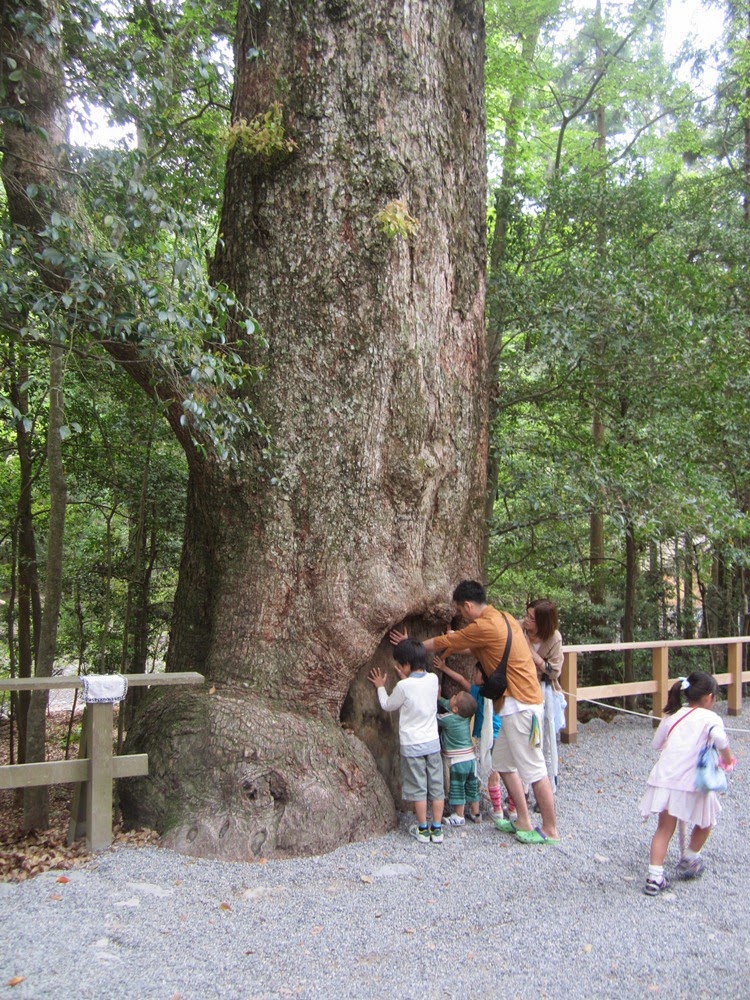
Old and huge trees were everywhere.


Shrine buildings are rebuilt every 20 years. It is not only a matter of construction, but is a religiously important event. The move means that they change the place to enshrine the god from the old building to the new building.

The latest shift was made last year at both the Inner Shrine and the Outer Shrine. It is now followed by other smaller shrines.

It becomes an open space after the old shrine building is removed. The space will be used again to build a new shrine 20 years later.

The shrine buildings are constructed in the way which the ancestors did more than 1000 years ago. They do not use even a single nail. Japanese cypress is used for the building itself and Japanese silver grass is used for the roof.

Plain woods appealed their freshness in the new-built shrines while mossy roofs appealed the history of 20 years in the old buildings. Old buildings will be dismantled and the wood will be used by other smaller shrines throughout the nation.

There developed commercial streets outside the Inner Shrine. Visitors enjoyed the local foods, sweets and souvenirs. Swallows flied over the street.


Tokaido Walk (29) Yokkaichi-Sakanoshita: May 4, 2014


It was a nice day today and I had a long walk.

I left Utsube in Yokkaichi City, walked through four shukuba stations -- Ishiyakushi, Shono, Kameyama, Seki -- and arrived at the entrance of Sakanoshita, the 48th station. 

It was about 25 km.

Ishiyakushi was one of the smallest stations in Tokaido in the Edo era. It is now a small town in Suzuka City. However, the impression was strong for me.

I found white flowers on the low bushy trees in various places in the town. It was U-no-hana or deutzia crenata. The flower is one of the symbols of early summer in Japan. 

I also found the plates of tanka poems written by Sasaki Nobutsuna. Sasaki was born here in the early Meiji period and became a famous tanka poet. He also wrote a lyric of U-no-hana song.

I had the impression that Sasaki and Tokaido were effectively used not only to attract tourists but also to enhance cultural activities in the community.


I visited Ishiyakushi temple. It was beautiful.


I moved into Shono, the 45th shukuba station from Nihonbashi. It is also a small town in Suzuka City. Wide rice fields spread outside the town. 


It was a season of rice planting. I saw old women working hard in a small field.

The Tokaido road became hilly as I passed Kameyama, the 46th shukuba station. The roads goes into the Suzuka Mountains.


I arrived at Seki, the 47th station. The old buildings are well preserved here. There are no utility poles and electric cables found. The town is registered as a nation's historic site.


I moved into a mountainous area and arrived at the entrance of Sakanoshita station. There were also rice fields in the small space in the area (the 2nd picture from the top). It is the last station in Mie Prefecture.


2014-05-03

Tokaido Walk (28) Kuwana-Yokkaichi (off Tokyo): May 3, 2014


I resumed my Tokaido walk using the “Golde Week” holidays. It was from Kuwana, the 42nd shukuba station from Nihonbashi, Edo (Tokyo), to Yokkaichi, the 43rd station.

Kuwana is the first shukuba station in Mie Prefecture. It locates at the side of Ibi River. The river flows downwards together with Nagara River and Kiso River into the sea.

People from Edo arrived in Kuwana by boats, not on foot. Miya (41st station) – Kuwana was the only part which was connected by the sea route, not by the land route.

The scene is completely different from that in the Edo era. Huge river banks have been built. Huge barrier (weir) was built at the month of Nagara River. The Nagara Barries cased a big debate on the balance of economic development and environment protection throughout the nation.

We could see the barrier from a sightseeing tower (in Japanese castle style) in former Kuwana port area.

Tokaido goes down to Yokkaichi. The street signs for tourists are well arranged.

Mie Prefecture is famous for its Ise-ebi lobster. I enjoyed it for dinner.


2014-04-16

Fresh green and spring flowers @ Jindai Botanical Gardens: April 13, 2014


Following yesterday, I had a walk to enjoy spring flowers and plants.

I visited Jindai Botanical Gardens in Chofu City, western Tokyo, and walked down (southward) along Nogawa River to Setagaya ward.

The forest of the botanical gardens was colored in fresh green. New leaves were rapidly growing in the trees. Birds sand and butterflies flied there.


Various spring flowers, including late-blooming cherry, azalea, violet, dandelion, and dogwood, were open. The combination of fresh green, dark green, pink, red, yellow and white colors were impressive.

The banks of Nogawa River were covered with rapeseed flowers. Walking in the area made me happy.


Fresh green @ Setagaya walking paths and Gotokuji Temple:April 12, 2014


Finishing cherry blossom season, Tokyo has entered into the fresh green season.

It was a beautiful day today. The sunshine was bright. I had a walk along walking paths in Setagaya ward and visited Gotokuji Temple.

Late-blooming cherry was open in the path. People enjoyed walks there. 


New leaves started to appear in Tulip trees. Leaves were only five to ten centimeters large. It will grow to 20-30 cm soon.


There were many maples trees with fresh green leaves in Gotokuji Temple.

I found several visitors, including a group, in the temple.

It is spring.


2014-04-07

Cherry blossom @ Chidorigafuchi, Imperial Palace: April 7, 2014


Tokyo is in cherry blossom season.

Its peak was last weekend (April 4-6), but it was still beautiful today. I visited Chidorigafuchi of the Imperial Palace.

Cherry flowers began to fall and leaves started to grow. The sky was blue and the air was fresh.


Many people were in small boats in the moat. Others were walking on the bank and taking pictures.


Only eastern gardens of the Imperial Palace are open to the public and western parts are closed. A cherry street in the western gardens is open to the public between April 4 and 8 this year for the first time in history. People are making long line to enter the site.

I was too busy to join the queue in the weekend.


2014-03-26

Shenzhen : March 17-19, 2014 (Off off Tokyo)


I had a business trip to Shenzhen, Guangdong Province, China.

The development of the city in the last 34 years, after it became China’s first special economic zone in 1980, is remarkable. It now has about 15 million people (including surrounding areas) and its par capita income is highest among the country’s major cities.

I did not have enough time to walk around the city, but I stopped at several interesting spots.

I had a dinner at a restaurant on a hill in Shekou, a ferry port in the western area of the city. Pictures of the old days (in the 1980s and 90s) were displayed. Deng Xiaoping’s pictures and words were impressive.

I visited Shekou about 30 years ago. Open air markets and shops were unsanitary. The situation has been completely changed.


I stayed in a hotel in the Mission Hills golf resort in the northern part of the city. They can play the games even in the night. Golf is becoming popular in the country.

I passed Hong Kong - China border by car. Check is made by both China and Hong Kong officials. Cards were making long lines.


2014-03-12

Spring flowers @Roka Park: March 9, 2014


Unseasonable cold days continue in Tokyo as cold wave stays over Japan.  Still, the day is becoming longer and it is getting brighter.

I visited Roka Park in Setagaya Ward.

Many trees were still bald, but spring flowers started to open. Rape seed flower was full open.

Spring is around the corner.