2009-12-23

Negish 2009.12.23


Negishi is an old town near Ueno (--> See “Ueno” article). Many artists used to live in the area.

Masaoka Shiki, poet and critic of Haiku and Waka (Tanka) in the Meiji Era, lived in Negish. His house “Shiki-an” remains here.

It is a small ordinary house with a small garden. Many artists and writers (including Natsume Soseki, Mori Ogai and Takahama Kyoshi) gathered here and exchanged ideas. It is why the house is seen as one of the birthplaces of modern Japanese literature.

Shiki got ill and had to stay in his futon (bed) for years till his death. He called the garden “my universe” and described the changes in the garden in his Haiku works.

The nation’s public broadcasting station broadcasts a program which focuses on Shiki and other Meiji people (including political and military leaders). The program (Saka no Ue no Kumo) is based on a novel written by Shiba Ryotaro, one of the most popular novelists in the country. So, Shiki is more popular now than before. More visitors come to Shiki-an this year.
There are many stone monuments which record Shiki's works in the area.

Hayashiya Sanpei was one of the most popular Rakugo Players in the Showa Era. Sanpei’s house has converted into a museum. (--> See Rakugo article)
His life-size pictures, books and many othere things are desplayed. Rakugo performances are often held here.

There are many love hotels (special hotels used for love affairs) in the area. The atmosphere of the town is far from sophisticated because of the hotels, but it is interesting to see the changes of the town from Shiki’s era.

2009-12-20

Ueno 2009.12.20


Ueno Park is one of the most famous urban parks in Japan. It has famous temples, concert halls, museums, zoo and universities as well as sports grounds inside the territory. People enjoy “hanami” (flower watching) picnic under the cherry trees in spring.

Shonobazu-pond lies in the south west part of Ueno Park. Lotus grasses cover the pond. They have dry leaves and grown-up lotus fruits at this season. There are many birds in the pond and people enjoy walking around the pond.

The Statue of Saigo Takamori, a leader of Meiji Revolution, is known as a symbol of Ueno. A religious group was holding a campaign in front of the statue.

The museums in the park include Tokyo National Museum, The National Museum of Western Art, The Ueno Royal Museum, and National Museum of Nature and Science, Tokyo. A life-size model of blue whale is displayed in front of the Nature and Science Museum.

The park is rather old. It became open to the public in 1873, just before the Meiji Revolution. The roads in the park are covered with asphalt.

The land was originally owned by Kanei-ji Temple, the guard of Tokugawa Family in the Edo era. Most od the land was taken over by the Meiji Government and it became the park. Kanei-ji Temple still remains in the northern part of the territory.

Tokyo University of Arts has its campus in the park. It has departments of fine arts and music. Old Music Hall of the university built in the Meiji Period still remains.

2009-12-19

Hiroo & Embassies 2009.12.19


Hiroo is a place where many embassies gather. They include French, German, Chinese and Finland. There are so many foreigners walking in the area.

The German Embassy holds a special exhibition to commemorate the 20th anniversary of the Berlin Wall’s collapse. Historical pictures are displayed on the wall of the embassy.

At French Embassy, a special exhibition titled “No One’s Land” is held. The Embassy has built a new office building and the old building is expected to be destroyed next year. The exhibition is held using the old building.

Rooms are allocated to artists and each artist shows his/her works in the room.

For me, some works were easy to understand and some were beyond my understanding. But all of them were impressive. I was also impressed by the idea of the embassy to have such exhibition.

Hatoyama Hall @ Otowa 2009.12.19


Japanese Prime Minister Yukio Hatoyama is from a distinguished family. His Grand-grand father served as lower house’s chairman. His grand father, Ichiro Hatoyama was the country’s Prime Minister, and his father was foreign minister.

The house now called Hatoyama Hall and is open to the public.

The Hatoyama family moved to Otowa in Bunkyo ward, northern part of central Tokyo in 1981 (maiji Period) and a western-style house was built in 1924, a year after the Kanto Great Earthwuake. A renovation was carried in 1995 and

The house was used for important political gatherings. The pamphlet says that Japanese postwar politics started here.

A slope leads visitors from the main street to the Hall. A video program played at a drawing room emphasized the great “achievements” of Hatoyama members. The records of former PM Ichiro Hatoyama (including appointment letters issued by the Emperor) and former Foreign Minister Iichiro Hatoyama are displayed. Various stained glasses are in the windows.

The atmosphere in the Hall is completely different from that in ordinary houses. Current Prime Minister Yukio Hatoyama’s unique character (he is sometimes characterizes as a spaceman-like person) may have been developed in this special mood.

The Otowa district is is also known as one of the centers of publishing industry. Kodansha, one of Japan’s leading publishers, has its headquarters here.

2009-12-06

Shinjuku Gyoen 2009.12.6


Shinjuku Gyoen National Garden is just 10 minutes walk from Shinjuku Station, Japan’s busiest station. There are many types of gardens and woods in it –- Japanese garden, English Garden, French garden, lawn garden and family’s woods etc. All are beautiful.

Shinjuku Gyoen is one of the best places to enjoy autumn red in Central Tokyo. (It is more difficult enjoy “red” than “yellow” in central Tokyo). Maple trees give us beautiful scenes there.

The garden is not free. The entrance fee costs 200 yen (for an adult). So, the garden was not so crowded and I had a good time.

2009-12-02

Communication Museum 2009.12.1


The Communication Museum is in the NTT Corporation’s headquarters building. It is in the center of Otemachi, one of the busiest business districts in Tokyo.

The museum displays goods related to postal services as well as telecommunications. They include: a model of postal office in the 19th century, stamps, posts, old telecommunication devices, fiber cables, telephones, and many other thins.

It is the season to start writing new-year greeting cards. The cards, known as nengajo, still play important role in keeping ties between people (even it is the time of e-mail). The museum was holding a special exhibition of nengajo.

Japanese postal services and telecommunication services started under the government’s operations. The services were later separated and were run by public companies such as NTT and Japan Post.

NTT was privatized in the 1980s although Finance Minister remains the largest shareholder.

Japan Post privatization law was enacted in 2005 under the Koizumi Administration. The plan is about to be reversed under the Democratic Party of Japan’s government in 2009.

BOJ Currency Museum 2009.12.1


Marco Polo, a Venetian traveler who visited Khblai Khan of Mongol Empire (China’s Yuan Dynasty) in the late 13th century, described Japan as a country of gold in his book. Indeed, Japan was a big producer of gold.

At the Currency Museum of the Bank of Japan, visitors find big oval gold coins. They were minted in the early Edo period, about 300 years after Marco Polo’s book. We also find silver, bronze and other coins of medieval Japan.

Coins and bank notes issued after the Meiji era (modern Japan) are also displayed.

The museum was not crowded. The staff answered politely to the questions by a group of students. I enjoyed the display.

The old headquarter building of the Bank of Japan was built in 1896. It was registered as national cultural property in 1974.

2009-11-29

Gingko @ Meijijingu 2009.11.29


Maijijingu Gaien (Outer Garden) is famous for its gingko trees.
The 300-meter street is called the “Gingko Street” and it is used in many cinemas and TV programs. More than 146 gingko trees are planted.

The street was crowded with families. I saw children spreading the fallen leaves.

The Gingko tree Festival was being held and stalls were open in the open space nearby. People were enjoying the season of the autumn color.

Kasumigaseki 2009.11.28


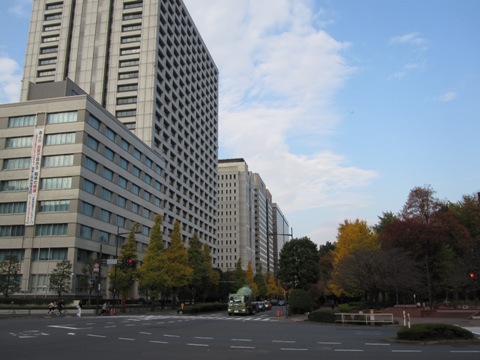
Many Japanese government offices have their headquarters in Kasumigaseki. The name of Kasumigaseki means the Japanese government or the bureaucratic system.

Some ministries keep old buildings build in Maiji, Taisho, and early Showa eras (1880s-1930s). The red brick-covered Ministry of Justice’s building was originally built in 1895. The powerful Ministry of Finance’s building was built in 1939.

Foreign Ministry’s building was built after 1960. Other ministries have relatively new buildings.

The power of the bureaucrats had been strong under the Liberal Democratic Party’s rule (1955-September 2009 with exception of 10 months). Under the iron triangle system (of politicians, bureaucrats and business leaders), the checks on the policies were weak, which enabled bureaucrats keep wide and strong power.

The situation is changing after the DJP (The Democratic Party of Japan) took power in September.

Bureaucrats work hard until late in the district. However, they worked harder (longer) decades ago. It was not easy to take lunch and dinner easily until 1990s, when convenience stores and other facilities had been introduced into the Ministry buildings.

Nagatacho, Japan's Capitol Hill 2009.11.28


Nagatacho is the seat of Japan’s Prime Minister Office as well as the Diet. That is why the name of “Nagatachi” usually means the Japanese politics (just like the Capitol Hill means the White House).

The huge National Diet Building was built in 1936. The left wing (from the front) is the lower house and the right wing is the upper house.

It is, of course, the place of legislation and political debates. But it is also used for other purposes. School children visit the Diet to study the country’s political process. Politicians invite their supporters from their constituencies. I saw sightseeing buses coming and many tourist taking photos (even tough it was Saturday).

The Prime Minister House stands at the other side of a road from the Diet. It is strictly guarded by policemen.

The office buildings for the Diet members stand behind the Diet Building. The National Diet Library is also in the area.

There is a public garden in front of the Diet. It is open to the public. The scene of the Imperial Palace from the garden is fantastic.